The Interesting Case of Jurassic World's Carnotaurus
One of the topics I love about de-extinction are topics about what would the effects the de-extinct animals onto the modern-day world. Ranging from smilodon hunting effects on modern day prey-animals to the welfare of dinosaurs in captivity.
Looking at this video, an interesting thing this guy pointed that got the attention of my 'de-extinction vibes':
Between 8:22 and 8:43, he talks about the different teeth between the Jurassic World carnotaurus and the Prehistoric carnotaurus. Basically, the JW carnotaurus has board and blunt teeth, whereas the prehistoric carnotaurus has long and slender teeth, like steak knives.
Why does this get my interest? Well, because this would definitely mean that the JW carnotaurus would have a different hunting strategy than that of the Prehistoric variety. You see, according to a study done on theropod dinosaurs in 2005, the prehistoric carnotaurus mostly hunted sauropods (long-necked dinosaurs) and it hunted them by slashing them so they could bleed to death (basically, it's a slasher version of a hit-and-run) with their long, slender teeth and their fast sprints (turns out that they are the fastest theropod dinosaur around, but could only do that fast speed at a straight line). Interestingly, it is theorized that allosaurus hunted this way too.
Interestingly, it is theorized that some species of terror birds (such as Andalgalornis) have hunted like this and are specialized in hunting large prey items.
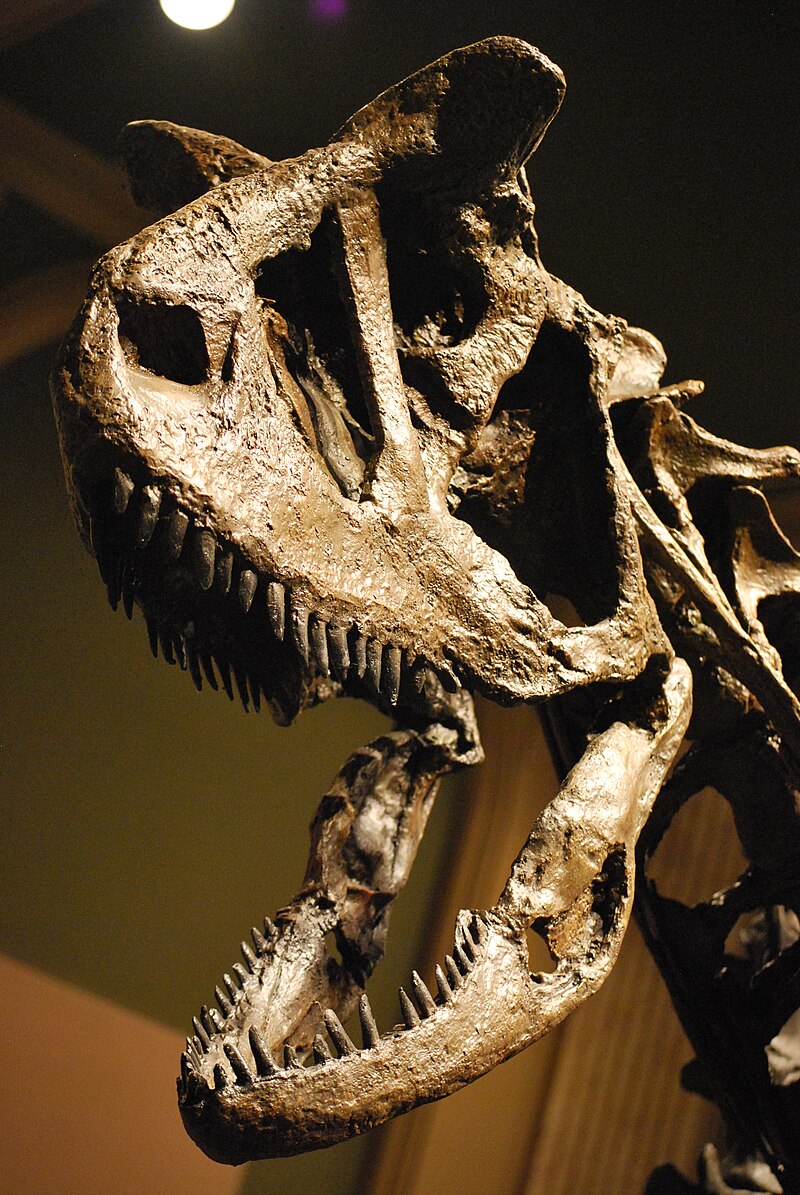 |
| Prehistoric Carnotaurus skull (Wikipedia) |
But, with the JW carnotaurus' teeth being more broad and blunt, it couldn't hunt like this. So, that meant that it had to hunt in a different way. So, it couldn't attack big prey safely and effectively as it's prehistoric ancestor (as shown in the Fallen Kingdom) and it couldn't go for much smaller prey (if it had the same the flexural strength of the lower jaw as it's prehistoric ancestor, that is), it might have to attack prey of the same size or near it so it could over power it.
Given what we know what is on Isla Nublar at that time, I could safely say that it mostly hunted Gallimimus, Pachycephalosaurus, Stigimooch, and the young of the larger dinosaurs (mostly of parasaurolophus). With the case of hunting gallimimus and parasaurolophus young, it would definitely be in competition with allosaurus (who, unless physiology says otherwise, can still hunt like it's ancestor and can go after sauropods, so this could actually save carnotaurus from being OVERLY competed by allosaurus) and Rexy (reason why Rexy bullied carnotaurus, much like how cheetahs are bullied by lions and hyenas SO often).
What is the point of this?
Well, while it is fun to speculate on subjects like this, I believe that it would be a good exercise for the real de-extinct animals.
For those who do not know what I mean, here's the short version of it all:
Due to the condition of the DNA of extinct species (even the more recently extinct ones) and other circumstances, it is impossible to clone a 100% purebred woolly mammoth, dodo, or thylacine. So, instead, you would need to heavily genetically-modify their closest genetic modern relatives (mammoth=elephant, dodo=pigeon, thylacine=numbat) with those ancient genes to make something similar to the extinct animal.
And this would beg the question; how would these animals react to these changes?
While they were born not knowing being anything else, they might have instinctual conflicts between their natural instincts with their modified traits. Would an elephant be conflicted about taking a mud bath with it's woolly coat? Would a pigeon instinctively try to fly, even if it is large and flightless as dodos? Would the pseudo-thylacine hunger for ants or wallabies more often?
These and other questions might need to be considered when bringing these 'de-extinct' animals into the world.
=References=


Comments
Post a Comment