Stegosaurus' 'Small-Minded' Solution?
With it's plates, thagomizer (spiked tail), and school bus-size, Stegosaurus is one of the most popular and well-known dinosaurs known to the general public and scientific community. Along with the mentioned traits, one of the Stegosaur's most well-known characteristics is that the said dinosaur has one of the smallest brains in the relation to body size (the stegosaur's brain consist of 0.004% of the animal's total weight, whereas the human's brain consists of 2% of the average human weight). While it is not the size of a walnut as popularly believed (more like between the size of a lime and a dog's brain), it is still pretty small for such a large animal.

While most people wonder about the stegosaur's small brain being a sign whether it was stupid or not, I myself have been wondering on why would such a large animal would have such a small brain?
Years later, I watched a Science Channel series called Mutant Planet, a document series that explores the many wondrous creatures of various habitats in our planet. One of the episodes was on the Brazilian cerrado (Brazil's own savanna) and one of the remarkable creatures it talked about was the giant anteater.

The narrator talks about some facts about the giant anteater, from it's long tongue to it's dependance on a diet of ants and termites. But one of the facts that really caught my attention was the fact that the anteater's brain is pretty small in relation to body.
Why?
As if he read my mind, the narrator went on to explain that even though termites have a good amount of protein, they are still a relatively lacking source of food. And in order to make the most out of this diet, you need to develop energy-saving methods to make due with less. One of the methods is to develop a smaller brain. This is because the brain is usually the one organ in the body that consumes the most energy. So by developing a smaller brain, you can be able to have enough energy to fuel up the rest of the body with what little you have.
Interestingly enough, the narrator also mentioned that there other energy methods that the anteater has:
Okay, so if the stegosaur's small brain is an energy saving technique, what kind of low-quality food was stegosaurus feasting on?
When I spoke of this idea to a paleontologist internet friend of mine, he told me about a blogger's theory about the stegosaur's diet. While he didn't remember who it was at the time, I later discovered it here on Cycad Fiddleheads and Stegosaur Neck Armor by Duane Nash.
Basically, Miser Nash's theory is that the armor on it's neck (also called gular armor or plates), while definitely used for protecting it's neck, is used for protecting it's throat from the prickly leaves while obtaining nuts and fruit from cycads.
When I look into this, it starts to make sense. For one, cycads such as one shown above were a common in the Morrison Formation (a formation in where Stegosaurus are found in). For another, their nuts can be a good food source for several (especially to some species of beetles) and a source of starch for flour, but can be relatively lacking. And recent studies of Stegosaurus' bite force shows that it could eat stronger food than previously thought and can be important for spreading seeds of several plant species (much like forest elephants in the African rainforest). Also, the stegosaur's narrow jaws would indicate that it was a picky eater and the same said jaws would be perfect for plucking a small piece of food out of a prickly location.
But during my study, there was one thing about cycads that puts a monkey wrench into the gears:
A great portion of cycads are poisonous, extremely so a great deal of animals. Some of them are so toxic, they can kill pets and livestock within 12 or so hours of ingesting them. If the nuts are not washed properly, they can cause neurodegenerative diseases to the victims that consume them as flour. Most animals that developed resistance to the toxins are usually small animals.
This definitely got in the way of my theory, if it wasn't for a paper called "Seed dispersal of the Australian cycad Macrozamia miquelli (Zamiaceae): Are Cycads Megafauna dispersed Grove-Forming Plants?"
Basically, the paper talks about the possibility that the Australian cycad is adapted to have it's seeds dispersed by the now-extinct megafauna (such as the rhino-sized wombat called Diprotodon (die-pro-toe-don)) back in the past (megafauna is the label for large animals, normally exceeding the weight of either 90, 100, or 2,205 lbs).
So, if even large mammalian herbivores can consume such food, then a dinosaur like Stegosaurus could do that too. But the question still remains: "How does the Stegosaurus deal with these toxins?"
Believe it or not, there several ways that Stegosaurus could be able to combat these toxins. I have listed four of these possibilities and they are as follows:
Storage?
One of the ways Stegosaurus could solve this toxicity issue is to just storing the toxins within their body tissues. Interestingly, by doing this, it doesn't kill them but it actually makes them poisonous or at least make specific parts of their body poisonous!
This is not very far-fetched, many animals do this:
That would be a fantastic idea if that were the case.
Gut Bacteria?
When we digest our food, we don't just rely on our digestive system alone to digest. We also rely on colonies of bacteria in our gut in order to assist us in digesting our food properly. Without them, it would be miserable for us.
It's not just in humans; cattle and other such animal use bacteria in their rumen (one of the four compartments of their stomachs) to break down and converts plant matter into energy and the gut bacteria of termites help them be able to digest wood.
But in some species, gut bacteria can do more than just help digest food.
In African rainforest, there are monkeys that possess specialized stomachs that possess gut bacteria that neutralize the toxins in several species of leave, especially those that produce cyanide!
So, if monkeys can be able to possess gut bacteria that neutralizes cyanide, maybe the Stegosaurus can possess that too?
Clay Consumption?
Another possibility is one that is currently used by some of the largest living land animals today:
In the African rain forests, forest elephants feast upon many species of fruits and leaves to sustain their diet. However, a good portion of these have toxins within them.
To combat this, the elephants would monthly visit a clearing in the forest, which is called a Bai (pronounced 'bye'), to obtain the mineral clay (along with other minerals and salts) neutralize the toxins they've consumed.
If even the large animals such as elephant did this, Stegosaurus might've done that too.
Less Toxic Varieties?
Another explanation would be that the stegosaurus would've focused on the less toxic varieties of cycad nuts and fruit.
The well-known Australian koala was known to feast on practically only on the leaves of eucalyptus trees. While there are 600 species of eucalyptus trees, koalas choose only 30 of them. The varieties they've eaten are the least toxic, along with being the more nutritious and least fibrous.
On an interesting added note: the koala also has a small brain in relation to body size and sleeps most of the day, much like the giant anteater.
Perhaps the same could be said for Stegosaurus?
Combo?
Even in nature, there no such thing as a silver bullet (meaning that there is not always a straight answer that fixes everything). While the possibilities listed above might help out in dealing with cycad fruit/nut toxins, just one them might not be enough.
It is quite possible that a combination of these might be in effect:
Perhaps they have gut bacteria that neutralizes most of the toxins, while the consummation of clay takes care of the rest?
Or their gut bacteria can not only neutralize the toxins, but also help the toxins to be transported to a part of the body where it can be stored?
Or while it might consume the less toxic varieties of cycad fruit/nuts, the Stegosaurus would still consume clay to detoxify the toxins it has stored?
Along with these, there are other possible combinations that the stegosaurus could use and each one of them is both possible and can help with cycad toxicity.
Why?
As I was figuring out why Stegosaurus had a small brain in relation to body size, what low-quality food source it was for, and how it could deal with such a diet, another important question came forth:
WHY would Stegosaurus go for such an extreme diet?
This question has been bothering me as well, to the point that it got me to investigate the other species of stegosaurs, to see if they can show any light on this.
As I looked up on the species of stegosaurs, one recently discovered species caught my eye:
The 'long-necked' stegosaur called Miragaia.
This recently discovered dinosaur is a stegosaur that elongated neck that makes it resemble that of the diplodocid sauropods (that includes Diplodocus and Apatosaurus). And interesting enough, the fossil record of the region where the Miragaia is found shows that out of all of the sauropods found there, none of them a low browsers (almost to grazing level) as the diplodocids.
It is interesting that in the absence of these kinds of sauropods, a stegosaur would develop a body plan similar to that of the said sauropods.
Coincidence? I believe not.
It has been noted in the past that animals would graze or hunt certain plants or animals not just because they are palatable to the animals, but they are the least pursued by their competitors. For example, in North America, coyotes would go after smaller animals because these said prey items are not a common food source for their competitors, the wolves (who have been known to kill them on sight). In areas where the wolves were eradicated, the coyotes started going after larger prey since the wolves are not there compete with them for the larger prey items.
With this in mind and all of what I have said prior to now, my hypothesis is that the Stegosaurus has developed it's particular body plan to consume fruits and nuts of cycads in order to prevent competition with diplodicid sauropods.
Really?
Could this be it? Could this be the answer for a long-standing puzzle of paleontology?
Currently, I can think of two questions that would go against this hypothesis of mine:
References:
While most people wonder about the stegosaur's small brain being a sign whether it was stupid or not, I myself have been wondering on why would such a large animal would have such a small brain?
Years later, I watched a Science Channel series called Mutant Planet, a document series that explores the many wondrous creatures of various habitats in our planet. One of the episodes was on the Brazilian cerrado (Brazil's own savanna) and one of the remarkable creatures it talked about was the giant anteater.

The narrator talks about some facts about the giant anteater, from it's long tongue to it's dependance on a diet of ants and termites. But one of the facts that really caught my attention was the fact that the anteater's brain is pretty small in relation to body.
Why?
As if he read my mind, the narrator went on to explain that even though termites have a good amount of protein, they are still a relatively lacking source of food. And in order to make the most out of this diet, you need to develop energy-saving methods to make due with less. One of the methods is to develop a smaller brain. This is because the brain is usually the one organ in the body that consumes the most energy. So by developing a smaller brain, you can be able to have enough energy to fuel up the rest of the body with what little you have.
Interestingly enough, the narrator also mentioned that there other energy methods that the anteater has:
- The anteater has the lowest body temperature of any mammal (around 90 F, cold compared to the human's 98.6 F!). A load of the larger species of dinosaurs show signs that they become more cooler in blood as they grow into adulthood and the plates on stegosaur's back has been speculated to be used for regulating it's own body temperature, so this would be possible.
- The anteater sleeps about 14 hours a day to also help conserve energy. The idea of a large animal sleeping around the same amount of time or similar would seem a bit off. But mind you that hippos are said to sleep most of the day in the water for the same reason the anteater sleeps as much as it does.
Okay, so if the stegosaur's small brain is an energy saving technique, what kind of low-quality food was stegosaurus feasting on?
When I spoke of this idea to a paleontologist internet friend of mine, he told me about a blogger's theory about the stegosaur's diet. While he didn't remember who it was at the time, I later discovered it here on Cycad Fiddleheads and Stegosaur Neck Armor by Duane Nash.
Basically, Miser Nash's theory is that the armor on it's neck (also called gular armor or plates), while definitely used for protecting it's neck, is used for protecting it's throat from the prickly leaves while obtaining nuts and fruit from cycads.
 |
| Example of a Soga 'Palm' or Cycas revoluta (Seeds for Africa) |
When I look into this, it starts to make sense. For one, cycads such as one shown above were a common in the Morrison Formation (a formation in where Stegosaurus are found in). For another, their nuts can be a good food source for several (especially to some species of beetles) and a source of starch for flour, but can be relatively lacking. And recent studies of Stegosaurus' bite force shows that it could eat stronger food than previously thought and can be important for spreading seeds of several plant species (much like forest elephants in the African rainforest). Also, the stegosaur's narrow jaws would indicate that it was a picky eater and the same said jaws would be perfect for plucking a small piece of food out of a prickly location.
But during my study, there was one thing about cycads that puts a monkey wrench into the gears:
A great portion of cycads are poisonous, extremely so a great deal of animals. Some of them are so toxic, they can kill pets and livestock within 12 or so hours of ingesting them. If the nuts are not washed properly, they can cause neurodegenerative diseases to the victims that consume them as flour. Most animals that developed resistance to the toxins are usually small animals.
This definitely got in the way of my theory, if it wasn't for a paper called "Seed dispersal of the Australian cycad Macrozamia miquelli (Zamiaceae): Are Cycads Megafauna dispersed Grove-Forming Plants?"
Basically, the paper talks about the possibility that the Australian cycad is adapted to have it's seeds dispersed by the now-extinct megafauna (such as the rhino-sized wombat called Diprotodon (die-pro-toe-don)) back in the past (megafauna is the label for large animals, normally exceeding the weight of either 90, 100, or 2,205 lbs).
So, if even large mammalian herbivores can consume such food, then a dinosaur like Stegosaurus could do that too. But the question still remains: "How does the Stegosaurus deal with these toxins?"
Believe it or not, there several ways that Stegosaurus could be able to combat these toxins. I have listed four of these possibilities and they are as follows:
Storage?
One of the ways Stegosaurus could solve this toxicity issue is to just storing the toxins within their body tissues. Interestingly, by doing this, it doesn't kill them but it actually makes them poisonous or at least make specific parts of their body poisonous!
This is not very far-fetched, many animals do this:
- The poison dart frogs from Central and South America get their infamous toxins from the the beetles they consume, which makes them so toxic that just by touching them can kill you (as your skin absorbs the toxins, so handle the wild frogs with protective care)!
- There is a bird in Papua New Guinea (the big funny looking island north of Australia) that is called the Pitohui (pet-tah-who-ee) is known to be toxic due to the beetles they are (which are actually the same kind of beetles found in the areas where the poison dart frogs eat them).
- There also other bird species that are toxic due to their diet, such as the African Spur-Winged Goose is toxic due to their diet of blister beetles and even North American quail would become toxic due to eating certain plants during some of their migrations.
So, if stegosaurus did store the toxins within their tissues, they would either store it within the majority of their tissues or in specific parts of the body. If the latter was the case, perhaps the stegosaurus could've stored the toxins within it's plates and thagomizer spikes as an advantage against Allosaurus?
That would be a fantastic idea if that were the case.
Gut Bacteria?
When we digest our food, we don't just rely on our digestive system alone to digest. We also rely on colonies of bacteria in our gut in order to assist us in digesting our food properly. Without them, it would be miserable for us.
It's not just in humans; cattle and other such animal use bacteria in their rumen (one of the four compartments of their stomachs) to break down and converts plant matter into energy and the gut bacteria of termites help them be able to digest wood.
But in some species, gut bacteria can do more than just help digest food.
In African rainforest, there are monkeys that possess specialized stomachs that possess gut bacteria that neutralize the toxins in several species of leave, especially those that produce cyanide!
So, if monkeys can be able to possess gut bacteria that neutralizes cyanide, maybe the Stegosaurus can possess that too?
Clay Consumption?
Another possibility is one that is currently used by some of the largest living land animals today:
In the African rain forests, forest elephants feast upon many species of fruits and leaves to sustain their diet. However, a good portion of these have toxins within them.
To combat this, the elephants would monthly visit a clearing in the forest, which is called a Bai (pronounced 'bye'), to obtain the mineral clay (along with other minerals and salts) neutralize the toxins they've consumed.
If even the large animals such as elephant did this, Stegosaurus might've done that too.
Less Toxic Varieties?
Another explanation would be that the stegosaurus would've focused on the less toxic varieties of cycad nuts and fruit.
The well-known Australian koala was known to feast on practically only on the leaves of eucalyptus trees. While there are 600 species of eucalyptus trees, koalas choose only 30 of them. The varieties they've eaten are the least toxic, along with being the more nutritious and least fibrous.
On an interesting added note: the koala also has a small brain in relation to body size and sleeps most of the day, much like the giant anteater.
Perhaps the same could be said for Stegosaurus?
Combo?
Even in nature, there no such thing as a silver bullet (meaning that there is not always a straight answer that fixes everything). While the possibilities listed above might help out in dealing with cycad fruit/nut toxins, just one them might not be enough.
It is quite possible that a combination of these might be in effect:
Perhaps they have gut bacteria that neutralizes most of the toxins, while the consummation of clay takes care of the rest?
Or their gut bacteria can not only neutralize the toxins, but also help the toxins to be transported to a part of the body where it can be stored?
Or while it might consume the less toxic varieties of cycad fruit/nuts, the Stegosaurus would still consume clay to detoxify the toxins it has stored?
Along with these, there are other possible combinations that the stegosaurus could use and each one of them is both possible and can help with cycad toxicity.
Why?
As I was figuring out why Stegosaurus had a small brain in relation to body size, what low-quality food source it was for, and how it could deal with such a diet, another important question came forth:
WHY would Stegosaurus go for such an extreme diet?
This question has been bothering me as well, to the point that it got me to investigate the other species of stegosaurs, to see if they can show any light on this.
As I looked up on the species of stegosaurs, one recently discovered species caught my eye:
The 'long-necked' stegosaur called Miragaia.
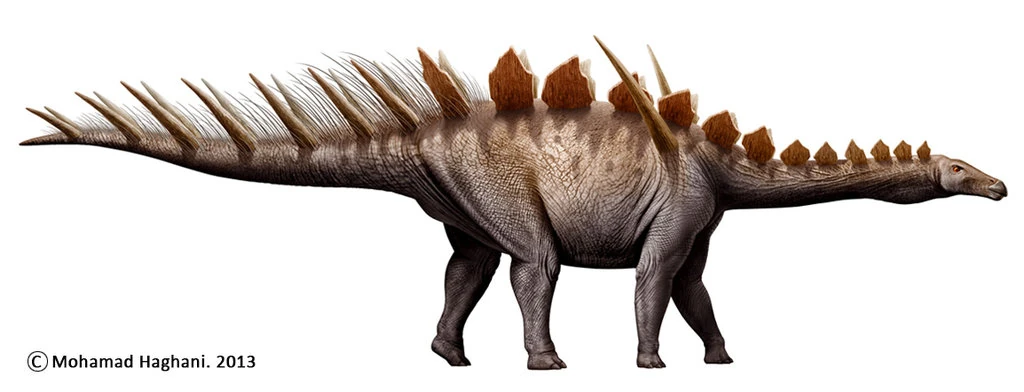 |
| Miragaia, named after a former civil parish in Portugal where it's remains were found. |
It is interesting that in the absence of these kinds of sauropods, a stegosaur would develop a body plan similar to that of the said sauropods.
Coincidence? I believe not.
It has been noted in the past that animals would graze or hunt certain plants or animals not just because they are palatable to the animals, but they are the least pursued by their competitors. For example, in North America, coyotes would go after smaller animals because these said prey items are not a common food source for their competitors, the wolves (who have been known to kill them on sight). In areas where the wolves were eradicated, the coyotes started going after larger prey since the wolves are not there compete with them for the larger prey items.
With this in mind and all of what I have said prior to now, my hypothesis is that the Stegosaurus has developed it's particular body plan to consume fruits and nuts of cycads in order to prevent competition with diplodicid sauropods.
Really?
Could this be it? Could this be the answer for a long-standing puzzle of paleontology?
Currently, I can think of two questions that would go against this hypothesis of mine:
- Wouldn't the sauropods go after cycads too?
- Would such large stegosaurs really survive on just cycad fruits and nuts?
To the first question, I would say this:
It might be possible that the said sauropods might occasionally consume a couple cycad nuts and fruits, but it's also possible that they did not.
But I would say that it would most likely not be the case. Because such large animals need a lot of food in order to support their large bodies and consuming a large amount of toxic plants would hinder or endanger their lives. So this could perhaps make them a bit picky eaters. It's not as far-fetched as it seems, elephants seem to be picky eaters too on situations like this.
With this in mind, I would that even if the sauropods did occasionally dined on some cycad fruits, it would've been so seldom that it wouldn't matter to whatever considers cycads a major part of their diet.
On the second question, I say this:
I would have to say that both yes and no.
Yes that large Stegosaurs would do alright on a toxic diet as that. As mentioned earlier, large herbivores can be picky and still be alright. Besides, while the stegosaurus is large compared to us, it is still considered small to the much larger sauropods and it seems to have the perfect adaptations to deal with such a diet.
And I could also say no that the stegosaurus would feast on such a diet ALL THE TIME. If having just cycad fruits and nuts doesn't sustain it for the long run, it could perhaps do it seasonally. It might be possible that their cycad consumption decreases when the diplodocids have migrated elsewhere and the cycad consumption increases when the said sauropods are present.
Conclusion
Well, this is my observation, hypothesis, and reasons. It might be the answer for that old question and mystery of the Roofed Lizard or it could perhaps be another idea that would be incorrect and wrong.
But that is what science is all about:
Ask, test, improve until you get the final answer.
=UPDATE=
12/10/17
Recently, I came across a species of dinosaur I never heard of called Isaberrysaura. It was a dinosaur that originally classified as an Neornithischia (includes dryosaurs, etc.), but it was recently classified as a basal stegosaur (due to phylogenetic analysis and that it's skull also seems stegosaur-like).
I'm pretty sure you are asking "So what's so important about this dinosaur?"
Well, quite a bit actually.
Anyway, another article has came up within this year showing a specimen of this species with it's gut contents perfectly preserved and guess what was within it?
Cycad seeds!
While more research would perhaps need to be done and more evidence needs to be found to make a full confirmation, it seems that it is plausible that most (if not all) stegosaurs are cycad-specialists.
=UPDATE=
12/10/17
Recently, I came across a species of dinosaur I never heard of called Isaberrysaura. It was a dinosaur that originally classified as an Neornithischia (includes dryosaurs, etc.), but it was recently classified as a basal stegosaur (due to phylogenetic analysis and that it's skull also seems stegosaur-like).
 |
| Isaberrysaura mollenis (Salgado et al., 2017) |
I'm pretty sure you are asking "So what's so important about this dinosaur?"
Well, quite a bit actually.
Anyway, another article has came up within this year showing a specimen of this species with it's gut contents perfectly preserved and guess what was within it?
Cycad seeds!
While more research would perhaps need to be done and more evidence needs to be found to make a full confirmation, it seems that it is plausible that most (if not all) stegosaurs are cycad-specialists.
References:
- Sander, P. Martin, et al. "Mesozoic plants and dinosaur herbivory." Plants in Mesozoic Time: Morphological Innovations, Phylogeny, Ecosystems (2010): 331-359.
- Mustoe, George E. "Coevolution of cycads and dinosaurs." Cycad Newsl 30 (2007): 6-9.
- Gee, CAROLE T. "Dietary options for the sauropod dinosaurs from an integrated botanical and paleobotanical perspective." Biology of the sauropod dinosaurs: Understanding the life of giants (2011).
- Hall, J. A., and G. H. Walter. "Relative seed and fruit toxicity of the Australian cycads Macrozamia miquelii and Cycas ophiolitica: further evidence for a megafaunal seed dispersal syndrome in cycads, and its possible antiquity." Journal of chemical ecology 40.8 (2014): 860-868.
- Butler, Richard J., et al. "Testing co‐evolutionary hypotheses over geological timescales: interactions between Mesozoic non‐avian dinosaurs and cycads." Biological Reviews 84.1 (2009): 73-89.
- Sporer, Dietrich Schneider-Michael Wink-Frank, and Philip Lounibos. "Cycads: their evolution, toxins, herbivores and insect pollinators." (2002).
- http://antediluviansalad.blogspot.com/2012/06/cycad-fiddleheads-and-stegosaur-neck.html
- Weishampel DB (1984). "Interactions between Mesozoic Plants and Vertebrates:Fructifications and seed predation". N. Jb. Geol. Paläontol. Abhandl. 167: 224–50.
- Reichel, M. 2010. A model for the bite mechanics in the herbivorous dinosaur Stegosaurus(Ornithischia, Stegosauridae). Swiss Journal of Geosciences 103, 235-240.
- http://rspb.royalsocietypublishing.org/content/early/2009/02/21/rspb.2008.1909.full.pdf+html
- Mateus, Octávio, Susannah CR Maidment, and Nicolai A. Christiansen. "A new long-necked ‘sauropod-mimic’stegosaur and the evolution of the plated dinosaurs." Proceedings of the Royal Society of London B: Biological Sciences 276.1663 (2009): 1815-1821.
- Martin, R. (2001). "Koala". In Macdonald, D. Encyclopedia of Mammals (2nd ed.). Oxford University Press. pp. 852–54.
- http://www.techtimes.com/articles/160023/20160522/dinosaur-study-reveals-strength-of-stegosaurus-bite.htm
- http://www.academia.edu/370771/Exceptional_Stegosaur_Integument_Impressions_From_the_Upper_Jurassic_Morrison_Formation_of_Wyoming
- http://news.jrn.msu.edu/capitalnewsservice/2017/01/06/coyote-wolf-conflict-affects-deer-mice-and-other-upper-peninsula-wildlife/
- http://www.krugerpark.co.za/kruger-park-news-african-elephant-picky-feeding-habits-25536.html
- Mateus, Octávio; Maidment, Susannah C. R.; Christiansen, Nicolai A. (2009). "A new long-necked 'sauropod-mimic' stegosaur and the evolution of the plated dinosaurs" (pdf). Proceedings of the Royal Society B: Biological Sciences. 276 (1663): 1815–1821.
- N.A. Christiansen and E. Tschopp, 2010, "Exceptional stegosaur integument impressions from the Upper Jurassic Morrison Formation of Wyoming", Swiss Journal of Geosciences 103: 163-171
References for Update
- Fenglu Han; Catherine A. Forster; Xing Xu; James M. Clark (2017). "Postcranial anatomy of Yinlong downsi (Dinosauria: Ceratopsia) from the Upper Jurassic Shishugou Formation of China and the phylogeny of basal ornithischians". Journal of Systematic Palaeontology.
- Salgado, Leonardo; Canudo, José I.; Garrido, Alberto C.; Moreno-Azanza, Miguel; Martínez, Leandro C. A.; Coria, Rodolfo A.; Gasca, José M. (2017). "A new primitive Neornithischian dinosaur from the Jurassic of Patagonia with gut contents". Scientific Reports. 7: 42778


Comments
Post a Comment