Speculative - Siberian Tiger in North America
"Tyger, tyger, burning bright,
in the forest of the night.
What immortal hand or eye
dare frame thy fearful symmetry?"
When we think of the word "tiger", we often think of exotic big cats that stalk the jungles and forests of India and Siberia, popular in Asian culture and artwork, and endangered by poachers and habitat destruction. The tiger was even a symbol of power, shown as mascots for sport teams, and many political debates and controversies of people privately keeping tigers in their backyards have been had!In the mentality of the Western world (specifically America), the tiger is an exotic animal from faraway lands.But at one time, that might not have been the case.In the Yukon of Alaska, fossils of Siberian tigers have been discovered that are dated to the Pleistocene era. Though heavily debated (especially with whether those fossils were lion or jaguar rather than tiger), it showed that tigers may have been at the Bering Strait land bridge.
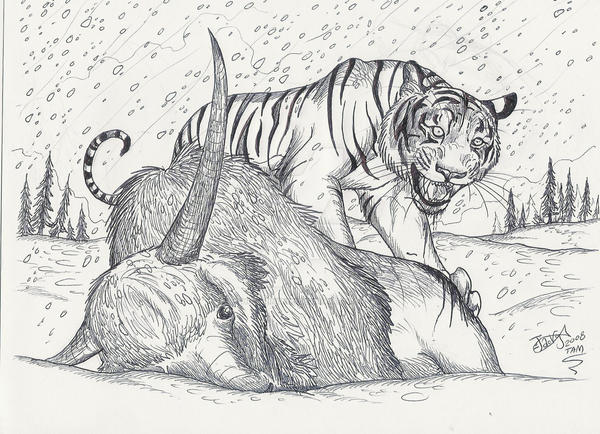 |
| Alaskan Tiger 2008 (HodariNundu) |
While the Bering Strait land bridge might've been mostly grasslands, there are possibilities of forests being present. Since other woodland animals, like moose, crossed the land bridge to migrate into North America, it is definitely possible for the tiger to move, as well.While these tigers existed in prehistoric times, they were no bigger than modern day tigers (306 - 100 kilograms or 675-220 lbs), so their behavior, diet, habitat requirements, and other characteristics were no different than that of living tigers. With this in mind, some scientists do say that tigers would be able to survive in North America.So if these tigers were no different than modern tigers and they were be able to survive America, one question remains:Why did these North American tigers go extinct?At first, one could argue that there was a lack of prey animals of the right size to support them, the same reason why the American lion or the saber-toothed cats went extinct. However, I doubt that theory. Mind you, these tigers were not of super-sized proportions. They were regular sized tigers. This means that their dietary requirements were not dissimilar to that of modern-day Amur/Siberian tigers (17.4 lbs. daily in summer & 23 lbs. in winter). Originally, I thought that the lack of the wild boar could be a possible indicator of the tigers' lack of distribution, but then I found this description of a study done with wild Amur tigers that went against this notion (paragraph from Wikipedia):"Between January 1992 and November 1994, 11 tigers were captured, fitted with radio-collars and monitored for more than 15 months in the eastern slopes of the Sikhote-Alin mountain range. Results of this study indicate that their distribution is closely associated with distribution of wapiti/elk, while distribution of wild boar was not such a strong predictor for tiger distribution."So, it is safe to say that wild boar was not an required for tiger distribution. As the description pointed out, elk/wapiti was a good source of food for the tigers. The elk/wapiti were one of the species that survived the end of the Ice Age that were of adequate size to feed the tigers, along with woodland caribou, woodland bison, moose, multiple species of deer, mountain sheep, etc.
(wikipedia.org) With these tigers being of regular size, and having a presence of adequate prey and preferred habitat, I would have to say the tiger had plenty of chances to establish themselves here after the Ice Age had ended.But why hadn't they?One possibility is that there were not enough tigers in the area. Without a high number of tigers, they were unable to establish a stable gene pool for themselves. Considering that tigers are solitary predators and need a lot of space to sustain themselves, it would seem logical that they would be small in populations. Then, when you also have competition with other predators (wolves, saber-toothed cats, american lions, etc.), it makes sense for the tigers' low population.Then, this begs the question:How can the tiger NOT be extinct?It seems that the best way to have helped the tiger population sustain in North America would have been for more tigers to migrate and help the American tiger gene pool. The best possible way for that to have happened is if there was an early, long-term flux in the populations of other predators that would have allowed more tigers to migrate.Let’s say that there was a flux in the population of other large predators via disease. Let's say lions, saber-toothed cats, and wolves (since they are social animals and diseases tend to hit social animals harder than solitary ones) experience great numbers of losses during the period of tiger migration. This might have allowed the prey animals to proliferate and encouraged tigers to migrate.When the Ice Age ends, some of the ice age prey animals (horses, sloths, mammoths, steppe bison, etc.) would die out due to climate and habitat change, and the animals that relied on them (lions, saber-toothed cats, and the short-faced bear) would also die out. With those animals gone, and the environment changing, the surviving species (tigers amongst them in this scenario) would take advantage of this change and survive.On a side note, it is quite possible that the tiger had a better chance than the American lion in surviving. This is because that the tiger is solitary (lions live in prides), can do well on smaller prey (due to being 25% larger, American Lions need more prey items), and live in forested areas (lions preferred open plains). American lions are much bigger, weighing in between 235 to 523 kilograms or 518 to 1,153 lbs., so they would need to eat more food than a tiger would need. With lions being primarily grassland animals, there's not much for them to hunt, especially since bison and elk are migratory.Once the climate warms up, glaciers melt, and the forests expand, the tigers and their prey would be able to spread out and establish themselves in this new land.....American Tiger Ecological EffectsIn the scenario of tigers surviving and establishing themselves in the North American continent after the Ice Age, I would imagine the tigers' range would include eastern Alaska, Canada, the Rocky Mountains, and all of Northern United States. The southern tip of this range could possibly be Northern Colorado, although one could argue the tiger was able to survive in more warmer regions. A large range would also have made the evolution of multiple subspecies possible.The tiger's preferred habitat would have been forested areas (taiga, deciduous, & coniferous), but could have also been grasslands as long as cover was available (the now-extinct Caspian tigers is an example). They could have also survived in nearby islands, such as Vancouver Island. In these environments, the tiger would have been more common where wapiti/elk were commonplace, just like they are now in Siberia. Woodland caribou, moose, and other species of deer would also be the major prey item, so tigers would have been more commonplace in forests where these animals resided.I would predict that in the Northern Woodlands, out of reach of the elk's range, the woodland caribou and moose would be the tiger's main prey item.
Along with elk/wapiti and relatives, tiger would have also hunted woodland/plains bison, raccoons, rabbits, hares, turkeys, heath hens, black bears, grizzly bear cubs, marmots, beaver, grouse, lynx, bobcats, bighorn sheep, dall's sheep, mountain goats, pronghorn (if they could caught them), musk ox, porcupine, trout, salmon, foxes, sea lions, seals, otters, badgers, mink, opossums, muskrats, and even tortoises/turtles (although not that often).Basically anything that is in the tiger’s territory would be potential prey, as this description on Wikipedia states:"Results of a three-year study on Siberian tigers indicate that the mean interval between their kills and estimated prey consumption varied across seasons: during 2009 to 2012, three adult tigers killed prey every 7.4 days in summer and consumed a daily average of 7.89 kg (17.4 lb); in winter they killed more large-bodied prey, made kills every 5.7 days and consumed a daily average of 10.3 kg (23 lb). When all sizes of prey are abundant, Siberian tigers prefer to target smaller prey."What this tells me is, in the warm months, tigers would mostly consume smaller prey (deer sized and down) once every week. But in the winter, they would target larger game (moose, elk, bison) every 5 or 6 days. I assume this was mostly because that larger animals hold more meat and the thick snow would hinder their speed, making it easier to take them down (much like wolves in Wood Buffalo National Park).As well as impacting prey animals, the presence of the tiger would have also affected predatory animals, as well.Tigers would occasionally hunt the black bears in Asia, so it would not be no different in America. The tigers’ predation on the black bear would affect the bears' behavior, perhaps making them spend more time in trees and even develop nest-building behavior (like the Asian black bears). They might have also become more aggressive than they are in our current world (like the sloth bear of India). Though rare, the tiger would might have been able to lure bears in via imitating their mating call. So, wherever the tigers they would have been, the black bear population would have been in check. With grizzly bears, the cubs would be at risk, and since grizzly bears are already known for their aggression, it could have been intensified with the presence of tigers.I would expect the relationship between the tigers and cougars (or mountain lions) to be akin to that of that of the tigers and leopards in Asia. By using the Asian leopard’s behavior as a model, it would seem that cougars would avoid tigers by hunting at different times of the day and hunting different prey. In our world, while cougars would hunt anything, they prefer ungulates (even-toed hoofed animals, like deer). In our American tiger scenario, hunting ungulates would have most definitely be kept to a minimum to avoid competition with tigers. However, that could change if the type of prey is in great abundance (studies with cougars and jaguars co-exist shows this) or the lack of tigers.Another North American predator that would be affected by the presence of tigers are the wolves. Back in Asia, tigers compete heavily with wolves; they've even been known for depressing wolf populations and hunting them without consuming them. In areas where tigers are commonplace, wolves are scarce on the ground. If they are together, it's most likely they would be pushed to the fringes of the forest along with the cougars.Much like their Asiatic counterparts, the coyotes, vultures, condors, crows, magpies, and ravens would scavenge off of the tigers’ kills and would even follow the cats to do so. Vultures and condors would scavenge off of their kills during the spring and summer, whereas crows, ravens, and possibly magpies would scavenge off of their kills during the winter months.On a curious note, the presence of the tiger might have had an effect on the California condor's habits. While the condor would still depend on marine deposits, the presence of the tiger would have increased the condor's diet percentage on land-based carrion. But, since tiger population concentration would still be light, it wouldn't be likely for condors to hunt further inland.Depending on how widespread the tiger would become on the continent, it might be possible that the cats would have competed with the jaguar. While that might have be the case, the jaguar has an edge over the tiger: the strongest jaws of any big cats that allows it to access sources of food that the tiger wouldn't usually go for (crocodilians and turtles). Additionally, while there are deer, tapirs, and peccaries in Central America, there are insufficient amounts of large prey to sustain tigers and the jaguar that is already there. So, with this in mind, it seems more likely that the tiger would not have migrated that far south.Cultural Effects of the American TigerAlong with effects to North American ecosystems, the tiger's presence on the continent would most have certainly affected the land's human culture.It is pretty obvious that the first culture to have been affected by the American tiger would have been the Native American tribes, obviously moreso those within the range listed above. Such tribes would include the Lakota, Crow, Arapaho, Cheyenne, Comanche, Shawnee, Cree, Blackfoot, Chinook, Cree, Ojibwa, and the Banook (just to name a very small number of them).One possible name for the tiger given by these would be the "Michipinchiwa" which is Miami-Illinois for "Big Lynx" (which is the name of a mythical cat in our universe). The tribes would even call it the "Water Panther", due to the water-loving nature of the tiger (in our world, however, it is because this mythical panther would drown it's victims).
Artist's impression of Native American Tiger image (myalltimelow098) Much as they were seen in Asia, the tiger would be a symbol of power and perhaps either nobility or greed. Unlike in Asia, while feared, the Native American tribes would give the tigers respect from a distance, bothering only if they needed to (hunting a man-eater or taking the pelt for a ceremony).As observers of the natural world, the tribes would undoubtedly notice the lack of wolves in the areas where tigers are commonplace. This could lead to the assumption or perspective that tigers and wolves are bitter rivals (much like the Chinese impression of the tiger and the dragon). It is likely that tribes would have included tigers in their legends on how the animals had affected their history and practices. With the tigers’ roars, it might be possible that (for the Souix and other tribes) they be classified as “roaring rivals” of the Thunderbirds (mythical eagles that cause lighting storms).There's another theory about the relationship between Native Americans and tigers. With the tiger being a man-eater, they could have easily affected the Native American communities. In Asia, tigers have been known to directly attack people more than any other big cat. They are said to be one of the few predators that would seek out human prey.Would this be the same in North America?I would say both yes and no.Yes, because tigers were problematic to rural communities in Asia due to the occasional lack of prey as a result of drought or over-hunting. In Asia, such stresses would make the big cats go for easier sources of prey (predicatble prey with large numbers and low escape ratios). The same would be said for American tigers.No, because while they do have some domesticated animals, the pre-contact tribes of North America did not have large animals that would be attractive to the tigers. The only domesticated animals the tribes had were turkeys and dogs; only the most desperate of tigers would go for those.Yes, because when not farming, Native Americans would compete with tigers for the same prey. When the tribes would run low on food tigers can't eat, they would hunt things that tigers would and if they needed to feed their families (bison, deer, moose, and elk). With that, this would create pressure between the tribes and the tigers that would result in conflict. Tigers may even follow the hunters taking their kills back home. For this reason, it is possible that the forested tribes would develop tiger-proof barriers around their huts to protect themselves (some tribes already did this to protect themselves from enemy tribes, but the presence of tigers might increase their need for it).No, because research has shown that the native tribes were experts of managing their environment: hunting deer and wild turkeys during breeding season so that they wouldn't have population explosions and destroy their crops. Undoubtedly, by doing this, they would have also managed tiger populations and prevent them from getting big in numbers and even making sure that they didn't cause their tribe any trouble (one would theorize that's what they did to wolves in the past).So, in short, the tribes might have had some issues with the tigers, but not as terribly as people in Asia had it. In summary, I assume the native tribes would have peacefully co-exist with the tigersHowever, things would change drastically when Europeans arrive to North America.-EuropeansWhen the pilgrims and other colonists arrived in the "New World" and saw the tiger, they would have quickly developed fear and hatred towards the animal. So much so that, just like the wolf, the tiger would be persecuted and hunted (also to protect their livestock and to preserve their "Manifest Destiny" later on). With the colonists not being knowledgeable about how to coexist with tigers and having larger livestock, the chances of tiger attacks would increase. Even cases of man-eating could have taken place. Tiger attacks would have been so effective on the colonists' minds that stories would be made about the man-eating instances, maybe even extremely exaggerated (like, maybe, "The Tiger of Jamestown", "Man-Eater of Plymouth", etc.). Man-eating tigers could even have been blamed for the disappearance of the colonists at Roanoke Island.


As European colonies and European descendants moved further into the continent, tigers would have been hunted down. The reasoning would be shear fear, protecting their livestock/community, or even their pelts. There is even the possibility that some communities would capture the American tigers for early zoos and circuses. They may have even resorted to selling them to royals back in Europe for possibly lower rates than Asian tigers due to European arrogance thinking that the American tigers were "inferior" to Asian tigers. There is also the possibility that, much like it was in Asia, nobles and royalties might come to North America to have tiger hunts for recreational hunting.
(Petit Journal, 1909) Europeans’ re-introduction of the horse would greatly have affected the humans’ relationship with the tiger and potentially expanded the tigers range.Horses had been in North America when the tiger first arrived in Asia. But, unlike the tiger in our scenario, horses became extinct on the continent until the Spanish brought the ancestors of the mustangs across the Atlantic in the 1500s. As the horses escaped into the wild, survived, thrived, and spread out, the tigers would have hunted the mustangs and no doubt saw them as potential prey. The pursuit of mustangs would even lead them to habitats where they normally wouldn't be (such as the deserts of Nevada). As tigers grew accustomed to preying on mustangs, the native tribes of the plains would have began taming and riding them. To the Native Americans, horses were much more than modes of transportation. Horses were seen as symbols of wealth, revolutionizing the tribes almost overnight by allowing them to move to new locations better, to hunt the buffalo and other prey more efficiently, and so on.With horses adding such value to the tribes, it would definitely seem to reason that that the tribes would see tigers as threats to their horses and would hunt more often just to protect their herds. It is possible that, much like how the Fur Trade affected the native tribes' hunting of fur-bearing animals to get metal tools and jewelry, tiger pelts would have also been in the mix and would have definitely been of high value and a high price. White fur trappers would do the same in hunting tigers for their pelts.As pioneers travel westward, the tiger would become more pursued and their range decreased immensely. With large numbers of elk killed off, and buffalo almost wiped out, along with their being hunted, and loss of habitat, the American Tiger would become regionally extinct in many areas until they were only found in the most remote areas (northern states, parts of Canada, and possibly Alaska).-Modern cultureScientifically speaking, one would imagine that the tiger would be called Panthera tigirus americus/atlantius/minor ("minor" due to possibly seeing American tigers as inferior)In history and the modern age, the tiger of North America would be called the "American Tiger", "Western Tiger", "Canadian Tiger", "Atlantic Tiger", "Snow Tiger", and several other names. Along with the common names of the American tiger, there would be subspecies called by their locations, like as in the "Colorado Tiger", "Pacific Tiger", "Lake Tiger", "Canadian Tiger", "Mississippi Tiger", "Yellowstone Tiger", etc (Native American names of the tigers have been suggested earlier).
Possible Hunting scene in scenario (nationalgeographic.com)

If the American Tiger survived to recent times in this scenario (which are pretty slim odds), there might be calls to protect them in the early to mid-1900s. The American Tiger would be classified as endangered, due to habitat destruction and conflict with agriculture. But there is also the possibility of the tigers being hunted by poachers for their hides, along with their teeth, bones, and internal organs for traditional Chinese medicine (much like the jaguars are in recent times). There’s even a slight possibility of exotic pet trade, as well.
When the populations of elk, deer, and bison grow and prosper, it is likely that the population of the American tiger would grow, too. And, just like with the wolves to Yellowstone, there might be areas where tigers might be reintroduced (most likely just wild tigers from other areas, not captivity-bred ones). It could be possible that the tiger might become a popular animal to see in Yellowstone and they may have helped with a current problem: bison are overpopulated and try to move out of the park, but get culled for fear of brucellosis. Tigers, along with cougars, might also have been seen as a solution for controlling the populations of mustangs in Nevada, feral pigs in Texas and Canada, and burros at the Grand Canyon. Conservationists might try to have people to allow tigers to stay because they could help take care of wolf populations (and we know what hunters and agricultural communities think about the wolf).
Along with wild populations, they would also be breeding the American Tiger in captivity. It might be tricky, since it is possible that a great number of captive tigers might've interbred with Asian races (from Bengal to Amur tigers) and there would be great efforts to separate them so that their bloodlines be pure. It is possible that breeders would work to determine how much Asian blood could be allowed in the American bloodlines (even go as far as making studbooks for such breeding programs).
Joe Exotic would've gotten American Tigers (express.co.uk) An interesting note on our scenario of the American Tiger is on how people would see them. In our world, tigers are often associated as exotic animals from far away jungles in our world. With tigers in North America, the general American perspective of tigers would likely be similar to that of bears and cougars in America: just another native animal. You could even imagine the tiger represented on flags and logos of their states.And this concludes the scenario of tigers establishing themselves in the North American continent.

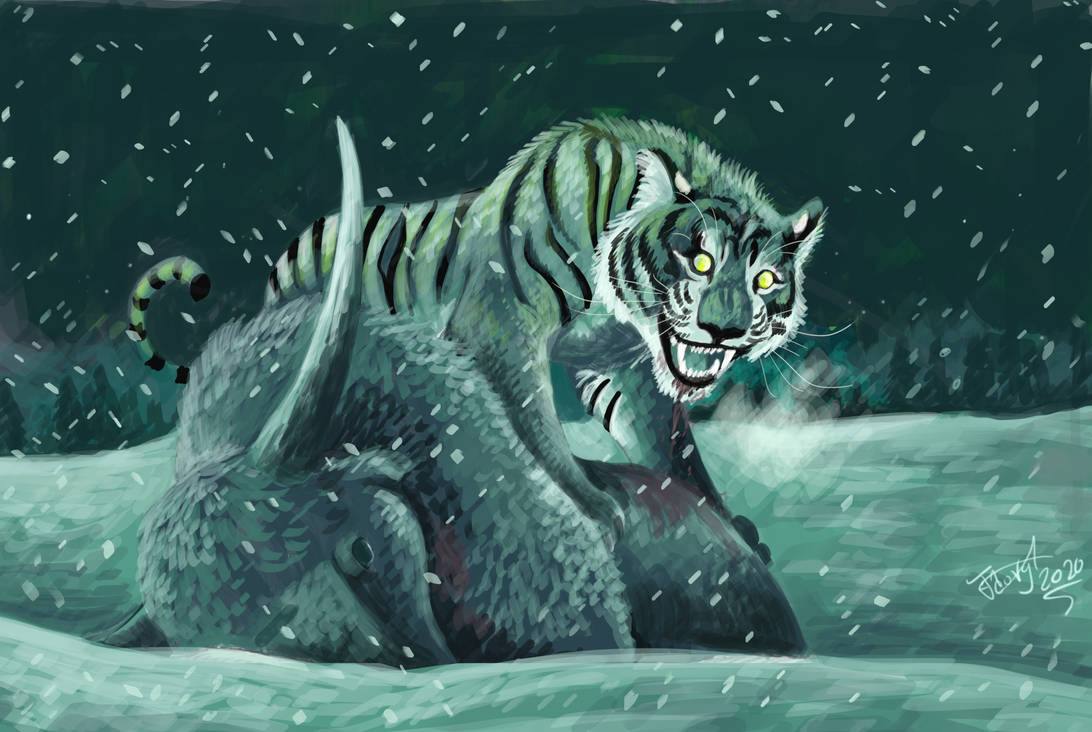 |
| Alaskan Tiger 2020 (HodariNundu) |
REFERENCES
Brown, Bear Behaviour and Activities
DeSantis, L. R.; Schubert, B. W.; Scott, J. R.; Ungar, P. S. (2012). "Implications of diet for the extinction of saber-toothed cats and American lions". PLoS ONE. 7 (12): e52453.
Gutiérrez-González, Carmina E.; López-González, Carlos A. (January 18, 2017). "Jaguar interactions with pumas and prey at the northern edge of jaguars' range"
http://www.adventure-tigers.com/d-tigers-america.html
http://www.hanskrause.de/HKHPE/hkhpe_22_01.htm
https://americanindian.si.edu/exhibitions/horsenation/impact.html
https://russia.wcs.org/en-us/Wildlife/Amur-Tigers/Amur-Tiger-Ecology.aspx
Iriarte, J. A.; Franklin, W. L.; Johnson, W. E.; Redford, K. H. (1990). "Biogeographic variation of food habits and body size of the America puma". Oecologia. 85 (2): 185–190
Miller, C. S.; Hebblewhite, M.; Petrunenko, Y. K.; Seryodkin, I. V.; DeCesare, N. J.; Goodrich, J. M.; Miquelle, D. G. (2013). "Estimating Amur tiger (Panthera tigris altaica) kill rates and potential consumption rates using global positioning system collars". Journal of Mammalogy. 94 (4): 845–855. doi:10.1644/12-mamm-a-209.1
Miquelle, D. G.; Smirnov, E. N.; Merrill, T. W.; Myslenkov, A. E.; Quigley, H.; Hornocker, M. G.; Schleyer, B. (1999). "Hierarchical spatial analysis of Amur tiger relationships to habitat and prey". In Seidensticker, J.; Christie, S.; Jackson, P. (eds.). Riding the Tiger. Tiger Conservation in Human-dominated Landscapes. UK: Cambridge University Press. pp. 71–99.
Miquelle, D. G.; Stephens, P. A.; Smirnov, E. N.; Goodrich, J. M.; Zaumyslova, O. J.; Myslenkov, A. E. (2005). "Tigers and Wolves in the Russian Far East: Competitive Exclusion, Functional Redundancy, and Conservation Implications". In Ray, J. C.; Redford, K. H.; Steneck, R. S.; Berger, J. (eds.). Large Carnivores and the Conservation of Biodiversity. Washington, D.C.: Island Press. pp. 179–207.
Thinley, P.; et al. (2018). "The ecological benefit of tigers (Panthera tigris) to farmers in reducing crop and livestock losses in the eastern Himalayas: Implications for conservation of large apex predators". Biological Conservation. 219: 119–125.


Comments
Post a Comment