Quolls - "Marsupial Cats"
When people hear the word marsupial (the group of mammals that rear their young in their pouches), they would instantly think of the koala, kangaroos, and opossums. When they are asked about any marsupials that are carnivores, they would think of the Tasmanian devil (largest living carnivorous marsupial) or even the Tasmanian tiger (the largest carnivorous marsupial that lived in recent times). But they would most likely not have ever heard of the second largest living carnivorous marsupial in the world, which are the quolls or the "marsupial cats".
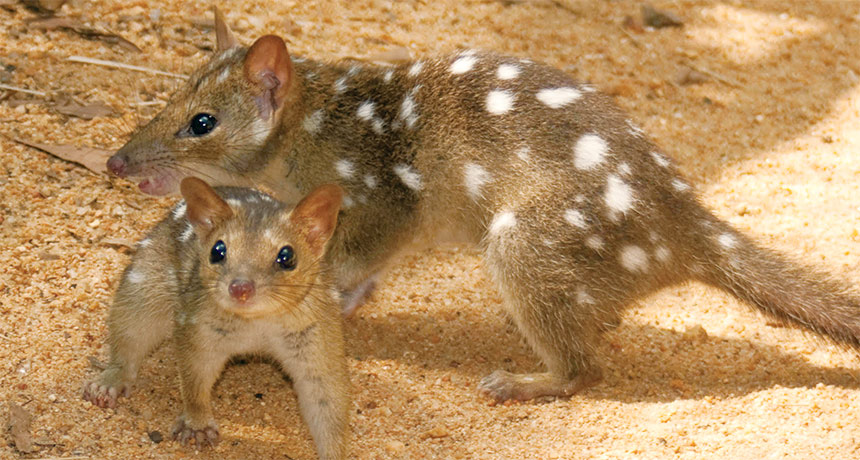 |
| Northern Quoll (Science News) |
There are six species of quolls in the world and they are as follows:
- Bronze quoll (D. spartacus), a seldom known species of quoll that is found in New Guinea and West Papua.
- Western quoll or chuditch (Dasyurus geoffroii), south-western corner of Western Australia, though used to be found over 70% of Australia.
- New Guinean quoll (Dasyurus albopunctatus), native to the island of Papua New Guinea.
- Eastern quoll (Dasyurus viverrinus), are now extinct on mainland Australia, now only found in Tasmania (or in fenced-in sanctuaries, where they were reintroduced).
- Northern quoll (Dasyurus hallucatus), the smallest of the quolls (350 to 1120 grams or 12.3 ounces to over 2 lbs) and are found in the northern parts of Australia.
- Tiger quoll or spotted tail quoll (Dasyurus maculatus), the largest of the quolls (3.5 to 1.8 kilograms or 7.7 to 3.96 lbs) and are found in eastern Australia with high rainfalls.
 |
| 6 Quoll species range (wikipedia) |
The quolls are native to the forests (arid to tropical) of Australia, Tasmania, and Papua New Guinea. While they can hunt in the trees, they are primarily ground dwellers and hunt their prey on the forest floor at night 9spending their days in their dens). They live solitary lives, unless looking for a mate or has joeys (offspring).
| (Smithsonian Magazine) |
.jpg/440px-Eastern_Quoll_(Black).jpg) |
| Wikiwand |
As mentioned much earlier, the quolls are marsupials, as in they nurture their offspring within their pouch. One of the interesting things about quoll reproduction is that the female's pouches are temporary, meaning that they appear only during breeding season. Their breeding season occurs in winter (June to August, since it's in the southern hemisphere) and during then, the males will search for a female in heat by using their senses of smell to track them down. After they breed, their gestational rate lasts for 21 days (as long as it takes for a chicken egg to hatch) and, while they can produce up to 18 joeys, only six will survive. When they get to nine months of age, they will move out of the pouch and go to the mother's back, staying there for six weeks. The six species of quolls have lifespans between 2 to 5 years.
Like a lot of small marsupials are in Australia, the quolls are in trouble from human-related activities. They are classified from Near-Threatened to Endangered. The threats to their survival are as follows:
- Loss of habitat, due to urbanization, livestock grazing, deforestation, and mining.
- Poisoned baits that were meant for invasive predators.
- Competition and predation from feral and non-native predators (feral cats, foxes, and feral dogs).
- The consumption of the poisonous cane toads, which happens due to frogs being a favorite prey item to quolls.
In response to the quolls' downfall, conservationists and other interested parties have made many measures to help these species to survive. Such measures are as follows:
- Captive breeding programs are underway and have been very successful, one facility even had 15 litters born in 2008.
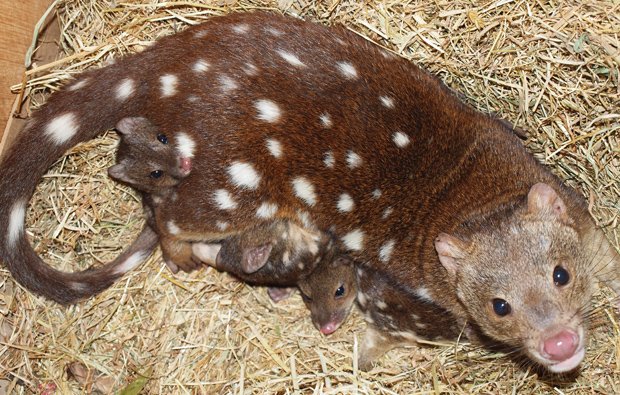 |
| Australian Geographic |
- The hunting and control of introduced predators (feral cats and foxes) has showed positive effects on the quoll populations and other native species.
- There have been talks about the possibility of introducing quolls into the pet trade as a way to aid in the quolls' conservation, but this is controversial and many experts are against it.
- Quolls have been reintroduced in many areas where they used to roam at and are protected, also considered to be a part of Australia's rewilding projects.
- Northern quolls are more successful in areas that are free of cane toads or that they could conditioned to avoid cane toads.
- They've also been protected on national parks, the bronze quoll are protected in areas like the Wasur National Park and Tonda Wildlife Management Area in Papua New Guinea.
- There is a population of quolls that have developed a gene that makes them avoid cane toads, now they are cross-breeding these quolls with other populations help them avoid the toads.
REFERENCES
"Australian Threatened Species, Tiger Quoll, Spotted-tailed Quoll or Spot-tailed Quoll, Dasyurus maculatus" (PDF).
"Baby quolls born on Australian mainland for first time in 50 years". ABC News. 9 July 2018. Retrieved 10 July 2018.
"Dasyurus albopunctatus". IUCN Red List of Threatened Species. Retrieved 20 October 2011.
"Dasyurus geoffroii". IUCN Red List of Threatened Species. Retrieved 6 November 2011.
"Dasyurus spartacus". IUCN. Retrieved 20 October 2011.
"Endangered Quolls breeding well in captivity in Darwin". Wildlife Extra. Retrieved 2 November 2011.
"Parks and Wildlife Service-Spotted-tail Quoll". Parks and Wildlife Service Tasmania. Retrieved 19 October 2011.
Cooney, R., Chapple, R., Doornbos, S., & Jackson, S. (2010). Australian Native Mammals as Pets: A Feasibility Study into Conservation, Welfare and Industry Aspects. Canberra, Australia: Australian Government - Rural Industries Research and Development Corporation.
Hopwood, P. (2002). Native Australian Mammals As Pets: An Overview. In D. Lunney & C. R. Dickman (Eds.), A Zoological Revolution: Using Native Fauna To Assist In Its Own Survival (pp. 77-83). Sydney, Australia: Royal Zoological Society of New South Wales and the Australian Museum.
https://www.backyardbuddies.org.au/backyard-buddies/quoll
https://www.nytimes.com/2018/07/26/science/australia-quolls-toads.html
Oakwood, M., & Hopwood, P. (1999). A Survey Of The Attributes And Requirements Of Quolls That May Affect Their Suitability As Household Pets. Australian Zoologist, 31, 365-375.
Viggers, K. L., & Lindenmayer, D. B. (2002). Problems With Keeping Native Australian Mammals As Companion Animals. In D. Lunney & C. R. Dickman (Eds.), A Zoological Revolution: Using Native Fauna To Assist In Its Own Survival (pp. 130-151). Sydney, Australia: Royal Zoological Society Of New South Wales And The Australian Museum.


Comments
Post a Comment