Jurassic World - An Animal Scientist's Review - 2015
Jurassic World - An Animal Scientist's Review
 |
| Movie Logo (from Joblo.com) |
=Introduction=
On June 11, 1993, a science fiction film called Jurassic Park was released in theaters. This film, which is about cloning dinosaurs and bringing them up in a theme park to be attractions and it all goes wrong, has became an instant success and is considered as a classic, even to this day. This movie has kindled the public’s interest in cloning, natural sciences, and, of course, dinosaurs. Among them was me, this film and it’s two later sequels have became a great influence on my life growing up (in what degree I will speak of later).
After watching Jurassic Park 3, I had heard rumors about a fourth movie, I was ready to see it. But since the script for it was in, and I quote, ‘development hell’, I was disappointed that it didn’t came. So, for 14 years I’ve been scanning the internet for any and all rumors, hints, leaks, anything about the fourth movie.
When I got the news about the fourth movie coming up as Jurassic World, I was hyped and excited for it to come up soon. At this time, I was finishing up my college years in Colorado State University, with a Bachelor’s Degree in Animal Science. As I hear more about this film, along with clips, leaks, and trailers, I was getting excited about it. But it wasn’t just the kid in me that was getting excited, but also the developing Animal Scientist in me. Looking at the leaks, clips, and trailers of that movie, I saw and noticed things that I have learned from my Animal Science-related classes, speakers, and my Animal Welfare Judging and Assessment Team. The more and more I learn about his film, the more and more excited both the kid and Animal Scientist in me became, to the point that I planned to do this review after watching the movie, bought my ticket at the 31st of May, and I even made a makeshift outline of this review weeks prior to the movie’s opening (using some of the information I have gained about the movie through the leaks, clips, and trailers).
When Jurassic World came into theaters in June 11, 2015, I went to the theater in Pueblo and watched the movie. And I would have to say, it was even a bit better than I had imagined and pointed more things that my Animal Scientist mind has noticed than before. It was so good that two days later, I watched it again. Even then, it still pleased me quite a bit and I’m desperately waiting for it to come to DVD (which I did get on October 2015) and for it’s sequel to come up.
At the same time, it made me become more excited about writing this review and has even made this review bigger than previously thought. Due to the content and size of this review, it will be broke into two parts; part 1 will be discussing about the overview, morals, ethics, and dinosaur behavior of the film, while part 2 will be a sort of evaluation of the park in the film as if it was a real zoological park, assessing the facilities of the park, exhibits, and even the welfare of the dinosaurs.
To all this, I shall start my review and I quote a line from the first film:
“Hold onto your butts.”
=========================
Part 1
Overview, Morals, Ethics, & Dinosaur Behavior
=Our Relationship with Animals Today=
Among the leaks of the film, one of them was a featurette that goes a little bit behind the scenes. It talked about what the movie’s gonna be like and about, what is in it, and so on. But among that, there was one line they said in there that really caught my mind and attention. What it was is that Co-Writer and Director of the film, Colin Trevorrow, said that Steven (As in Steven Spielberg, the executive producer of Jurassic World) talked about an idea of a movie that talks about our relationship with animals on our planet right now. This has really caught onto me because this was something that has been mentioned many times in my years of earning my degree in Animal Science. While my classmates and I learn about the nutrition, breeding, genetics, behavior, and even the economics of animals, we learn about how our relationship with animals, both the good and the bad.
In the film, there was a line that a character, who is the human villain of this film, said and it was that “Extinct animals have no rights”. Also, there was a line from the second Jurassic Park movie that a character (who is also a sort of villain as well) who said that “An extinct animal brought back to life has no right. It exists because we made it, we patented it, we own it.” Unfortunately, this kind of thing won’t just imply to resurrected extinct animals in the future or transgenic (genetically-modified) animals, but it also applies to any and all animals. This would go to livestock, zoo animals, wildlife, pests, invasive animals, and even pets. Like how the late John Aspinall, British zoo owner and gambler, said in an award-winning documentary film called A Passion to Protect, when people speak blindly about animal rights, the truth is that animals have no rights whatsoever. So it would be immature and inaccurate to scream out that animals have their rights, whereas they have none at all. But the rights that animals can have and receive are those that we (us humans as either individuals or society) are willingly and able to give to them.
These ‘rights’ we are willing and able to give to animals are what we in the animal welfare department call the ‘Five Freedoms’ or Brambell’s five freedoms (after the british medical scientist, Francis William Rogers Brambell, who brought up the creation of them thanks to his 1964 book called Animal Machines, in response to the treatment of livestock). What they are is a compact list of rights for animals that are under human control and containment, such as livestock intended for food and work. Originally developed by in 1965, in the UK from a government report on the treatment of livestock, these freedoms are being used by animal welfare experts from across the world in elevating the welfare of animals in all facilities (other than livestock, which was the five freedoms’ original purpose). These five freedoms are as follows:
- Freedom from hunger and thirst: Adequate food and fresh water should be available to the animal
- Freedom from discomfort: The animals should be able to have an appropriate shelter and comfortable resting place
- Freedom from pain, injury, or disease: The animal should have prevention of ailments or a immediate diagnosis and treatment
- Freedom to express (most) normal behavior: Should have adequate space, proper facilities, company of one’s kind, and enrichment to avoid the development of abnormal or stereotypic behavior.
- Freedom from fear and distress: The animal should have conditions and treatment that prevents it from being in constant stress or mental suffering
More details and examples of these five freedoms will be explained and used in the next part of this review. But know that any kind of rights these animals should obtain, it would be those. These kinds of rights should be given to all kinds of animal within our care and captivity, especially cloned and transgenic dinosaurs.
=‘Animals as Assets’ Point of View=
Among the leaked clips of the movie, the first leaked clip of the movie shows Chris Pratt’s character talking with Bryce Dallas Howard’s character interaction that brings up some good points about the viewpoint of animals today:
Now, aside from the humorous parts and sides, there is some pretty good things they have pointed out here that I have seen and been told about during my years of earning my degree. One of them was that Bryce’s character calls the animal of topic ‘the asset’. It’s just not restricted to that one individual animal, throughout the first half of the film, she kept preferring to all the animals as assets. Now, while she seems to be the only person in the movie that calls the animals as such, this trend is much closer to reality than one would think. As the agriculture industry becomes more industrialized, a great number of companies have become more like factories than anything else (or factory farms). With this, their viewpoint of their animals change from being living creatures to just merchandise or products, pretty much like car companies see the cars they develop or shoes in shoe companies. This means that while they maybe fed and watered, their welfare requirements are barely met (in short, their freedom from hunger and thirst are met and their freedom from pain, injury, or disease are somewhat met, but all their other freedoms barely met or not met at all).
This was one of the many things that we have been warned about by our animal scientist instructors, speakers, and philosophers. We have been warned about this and to fight against it. Not because that it is wrong to gained money from animals, we need a great number of the services that they do for us for our well-being and our society (getting money isn’t always a greed issue). We were taught to go against it because it is not only the right thing to do, but when the welfare, husbandry, and the well-being of the animals are met, it would actually make the animals more profitable that way. For example, in order for your beef cattle to be healthy and gain efficient body weight for slaughter, they must not be so stressed out all the time; this can be achieved by providing shelter from intense sunlight to weather conditions, removing noisy or disturbing objects that spook the cattle constantly, make sure that they have a dry pen or a large dry spot in your pen so that they don’t have to stand in mud or puddles, and so on. By doing this, your cattle are less stressed and therefore, are more profitable. Basically, happy animals are profitable animals.
This would also help you in avoiding troublesome ordeals in relation to your animals. For example, by providing the rich environment and a positive (but discipled) relationship with your animals will also decrease the chances of negative or destructive behavior targeted at your resources or yourself. That is why the Chris Pratt’s character was able to have an effective cooperation with the raptors, which will be explained later. To not do these things would have disastrous consequences and I believe that is one of the reasons why the hybrid dinosaur in the film became such a monster. But, again, that will be explained in further details later.
And the whole ‘numbers on a spreadsheet’ is not always that bad. Why I say that is because it is not always easy using regular names to identify animals, since a load of them could have names that are the same or are very similar to each other. A better way explaining this is on how we use social security numbers, student ID numbers, or code names in our society. This makes things easier because there’s a load of people who share the same first names and even whole names (It’s actually kinda scary on how many people share my first and last name at the same time). As those kinds of numbers help us out with our fellow man in society, the same thing goes for animals. In a large feedlot or dirt farm, you could use an ear tag number to identify any animal that needs medical attention or is about calves out of the hundreds or thousands of cattle in that one feedlot or dairy farm. Another example would be that in websites that are for breed organizations (like the American Angus Association or the Thoroughbred Owners and Breeders Association). If you wanted the semen of a certain bull or stallion out the hundreds of bulls or stallions, you can use it’s studbook number to be able to fish it out of all those males.
So while the ‘numbers on a spreadsheet’ can be useful in identification or business, it can be mislead people from the simple fact that Chris Pratt’s character (Owen) displayed in the clip:
“They’re alive.”
You have to remember that each one of those sets of numbers is a living creature, as in that it has emotions, can feel pain, have different personalities, and have more going on in their heads than just instincts. And that all of those things can have effects on your success or failures in relation to either one of those animals. Another things that Owen said after that also brings up more things in mind:
“You may have made them in a test tube, but they don’t know that.
They’re thinking ‘I gotta eat.
I gotta hunt
I gotta -*moves fist back and forth, indicating sexual intercourse*.’
You can relate to, at least, one of those things, right?”
Humor aside, there is definite truth to that. For example, a single male pig in a crate at a factory farm maybe conceived via artificial insemination or AI for meat production, but he doesn’t know that. In his head, he’s just thinking that he’s in a environment where he is getting food and water, but the floor is way too hard (causing sores and other leg injury-related issues), the thing that is containing him can not let him turn around or move much, he is not having to the amount of social interaction that he desires to have or had when he was a piglet, and he doesn’t have anything to chew up and destroy (such as straw or anything similar) to occupy his time, so he has to chew on the bars of his crate (which hurts his mouth and is unhealthy, but does it anyway because he is that bored).
So, while it is important (in a business perspective) to know or remember what this animal was bred for, it is still important to remember that this animal doesn’t know that and still needs to be given what he (or she) needs and wants to become happy or content (while not spoiling it at the same time), which later makes it profitable.
=Dinosaur Behavior in the Film=
In Jurassic Park, Steven Spielberg and his team didn’t want their dinosaurs to just be monsters running around, eating people on sight. They wanted to show them as they what they really are: animals, just ‘plain’ animals. To do so, they incorporated several animal behaviors into the dinosaurs in the film, but what will be in a future post.
The same is said for the dinosaurs in Jurassic World, even with the Indominus rex, the hybrid ‘monster’ dinosaur. Sometimes, these behaviors can be seen and understood immediately, while others are a little bit more clever and can be trickier.
 |
| The Triceratops rising up in response to the Gyrosphere (the giant 'hamster ball') reminds me greatly of how cattle would rise when I walk by them, exactly in behavioral detail (Screenshot from JurassicWorldNews.com) |
 |
| The animal's panic reaction to the gyrosphere's sudden speed up is a common reaction that wild herbivores have to sudden surprises, showing that these animals are still wild animals (belongs to Universal Studios) |
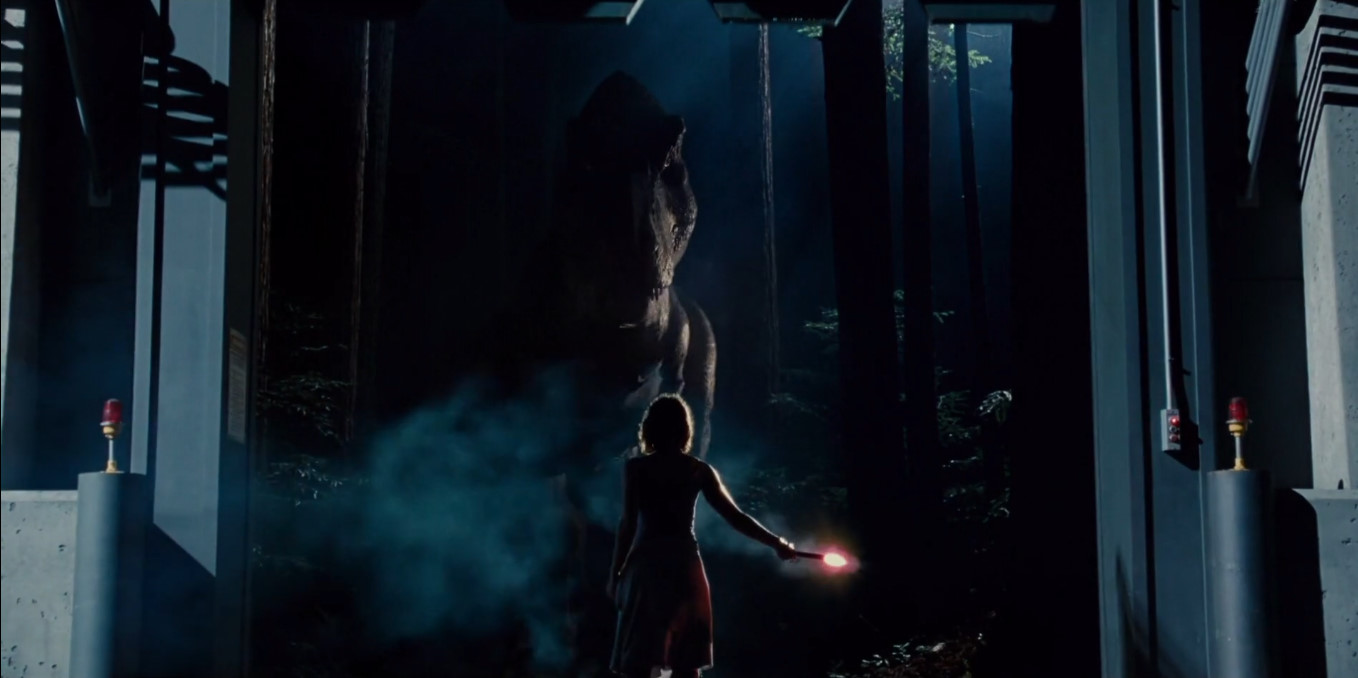 |
| Using a flare to attract the T-rex is similar to how zoo-keepers would attract their animals to certain places in a low-stress manner, using sounds and colors (screenshot owned by Universal Studios) |
=I-Rex's Social Behavior=
In the later part of the film, the Indominus rex was actually able to communicate with the raptors and even have them turn on the humans (just for the raptors to turn back on it later). In that scene, Owen figured out that the I-rex is in fact part Jurassic Park raptor (which definitely explains the great intelligence it possesses). Now the question is that could it be that possible for an animal to be able to communicate to a very different species of animal with a simple genetic modification with the genetics of that different species?
The answer to that question is a somewhat shaky yes.
On the idea that a simple genetic modification can change an animal’s means of communicating is plausible and has actually been done. In Germany, 2009, a team of scientists have modified mice with a human variant FOXP2, a gene that is partially responsible for what makes our vocal language different than that of any other species. What the result was is that the mice’s squeaks changed, along with the size and shape of their neurons.
Now, this doesn’t mean that we will have mice talking to us like Mickey Mouse or Stuart Little, but it does show that a simple change in genetics can affect an animal’s communication. In fact, mutations in the FOXP2 gene in humans causes speech and language disorders. So, if the I-Rex was given the right amount of communication and language-controlling genes from the JP raptors, it would stand to reason that the I-rex can be able to speak to the raptors.
However, genetics is only part of the equation, another factor is needed for this scenario: it needs to the environment for it.
In other words, it has the nature to speak raptor. But it needs the nurture to speak raptor.
We all have heard of the expression or debate of “Nature vs. Nurture”, meaning that an animal’s behavior is either influenced by the animal’s genetics or by the animal’s upbringing. This has been hotly debated for over a century. Today, we are able to understand that it is both nature AND nurture that defines or shapes an animal’s behavior (one doing more than the other at times, depending on the situation).
For example, songbirds raised in isolation are shown that while they are capable to developing singing behavior, they need to be raised by or with another member of their own kind in order to get their songs correct.
 |
| (from mindsmachine.com) |
So, since the I-rex seems to have never been in contact with raptors before that scene, it would seem that the I-rex developing the correct communication and language skills important for talking to raptors would seem unlikely.
But there is in fact a way for the Indominus rex to be able to develop the language and communication skills in a sort of correct matter:
It was mentioned and even shown in the opening scene of the movie that the I-rex we come to know was not alone, it actually had a sibling in case it didn’t survive. It was raised with that sibling . . . . until she ate it. While this seems like a minor detail that leads to something disturbing, it is in fact an important factor for this situation.
Studies have shown that animals raised with siblings have developed better communication and language skills with other members of their own kind (and similar species) than those who were raised alone. When weaned and separated from the group, they are more likely to get along with other members of their own kind and related species. While they never mentioned when the I-rex ate her sibling, I could imagine that the sibling was alive long enough for the I-rex to be able to develop communication and language skills, with the help of it’s sibling (since it’s sibling is another I-rex as well and is no doubt able to speak raptor as well) before our I-rex helped itself to the sibling.
. . . . . Information Skip . . . . .
=Paleontological Inaccuracies & My Response to Them=
As with Jurassic Park movies or ANY dinosaur films, there is always gonna be paleontological inaccuracies that fellow dinosaur lovers are going to point out. To not waste too much time, I’m gonna list them down:
- Real velociraptors are feathered, the size of turkeys, smart as ostriches (or cats), the palms of their hands face each other (like as if it’s applauding), they definitely can’t run at speeds of 40-50 mph (let alone, catch up to an ambulance or a motorcycle), and it is debatable if they did hunt or live in packs.
- Tyrannosaurus rex most likely had downy feathers covering most of it’s body or just a bit.
- Tyrannosaurus can see you, whether you’re moving or not.
- The Mosasaurus is WAY too big (several times larger than the largest mosasaur and a couple times larger than the blue whale).
- The mosasaur should have a shark-like tail (fin wise), instead of a crocodile-like one
- Pteranodons CAN’T lift with their back legs, for they are weak there.
- Apatosaurus is supposed to have spines running down it’s back (like an iguana)
- Triceratops is believed to have bristles on it’s body (due to one of it’s smaller cousins, Psittacosaurus, having bristles)
- Pteranodons can’t exactly dive into the water and pull out prey, like gannets and other sea birds can.
- Raptors were more likely tree climbers instead of runners.
- The palms of t-rex’s hands are supposed to be facing each other as well, not ‘bunny-handed’, like the raptors are.
- Dilophosaurus did not have a frill, as taller than it is on the film, and it is doubtful that it was venomous.
- The tongue of the mosasaurus is supposed to be forked, like a snake or the komodo dragon, it’s closest living relative.
- Gallimimus (the ostrich-like dinosaur) should have feathers and 'applauding hands' as well.
And there are perhaps many other paleontological inaccuracies in the film that I can’t count or don’t even noticed. But, while there are paleontological inaccuracies in this film, there are actually paleontological accuracies that my fellow dinosaur fans can at least appreciate. These are:
- The nostrils of the Apatosaurus are at the right location on the skull and are located at the snout, not on the forehead as previously believed.
- The teeth on the palate of the mosasaur’s mouth is an actual trait of mosasaurs, used to keep a hold onto their prey while biting on them or swallowing them, like snakes do.
- The Dimorphodon (the pterosaur with the tails and big heads) have hair-like structures on their backs, much like what has been found on their fossils and that of other pterosaur species.
- The forest that is inside the t-rex’s paddock is pretty much like how it’s natural habitat was like.
- The skull structure of the mosasaur is the exact same as that of the mosasaurs (except for the obvious size).
- The infant Triceratops had stubby horns that curved backwards, which is the actual trait of infant Triceratops fossils.
- Just like in all of the Jurassic Park movies have shown, Jurassic World has shown that the dinosaurs are active animals, not sluggish, tail-dragging brutes as it was commonly believed before Jurassic Park.
- One of the characters talked about the preservation of biomolecules within dinosaur bones, which has actually happened.
While these accuracies are still there, it doesn’t exactly cover up the inaccuracies in the film’s dinosaurs, even to the point of no forgiveness to most paleontologists.
But what is my reaction to all this?
Well, I think that due to the nature of how the dinosaurs came to be in the film (genetically-modified clones), I would say that the inaccuracies in this film are forgivable in that sense. In the third Jurassic Park movie, Alan Grant (played by Sam Neil) had said these dinosaurs are "genetically-engineered theme park monsters" (although, I personally would've preferred that he would've used the term 'animals' instead of 'monsters'). Even in the Jurassic World film, Dr. Henry Wu (played by BD Wong) said that nothing in Jurassic World is natural, that they've always added the DNA of other animals into the gaps of the dinosaur DNA fragments, and that if any of the dinosaurs were pure, a lot of them would look very different than what they look like in the film.
This would be closer to reality than one would think. When trying to find DNA from dinosaurs, woolly mammoths, Saber-toothed cats, dodos, and tasmanian tigers, you may be able to find fragments of their DNA, but you could NEVER find a full strand of DNA to use. But there is also another problem, DNA is only part of the way to bring back a pure clone of the animal in question. You will need the proteins that work on the DNA, mitochondria DNA, RNA, and many other molecules that help make an animal as it is. In other words, in order to produce a 100% pure extinct animal reborn, you would need an intact cell from a precise perfectly preserved or 'living' tissue (as in it came from a living individual animal quite recently) and the chances of anyone finding that is EXTREMELY unlikely to impossible.
But, there is another way of getting a woolly mammoth or a dinosaur . . . . .
Gene-Modification
The idea is that you would take the DNA of a living relative of the extinct animal and modify it with the DNA fragments from the extinct animal. For example, you would take the DNA of an Asian elephant, cut out certain genes that are un-needed, and replace them with the genes from woolly mammoth DNA so that the resulting elephant would have the various traits of the mammoth (e.g. wooly hair, larger tusks, blubber, anti-freeze blood, etc.). By doing this, you wouldn't have a pure-bred mammoth, but you would get a mammoth-like creature.
 |
| Possible safari trip in the near future? |
And this sort of thing has already happened!
In this year (2015), scientists in Harvard University have already altered the cells of the asian elephant with that of the woolly mammoth and they are one big obstacle away turning those cells into a living 'mammoth', but that is a topic for a future post.
In 2008, scientists in Australia have modified mice with some of the genetic material of the thylacine or tasmanian tiger. When they did this, the thylacine's genetic material operated like it was turned back on. While this doesn't mean that the mice will have stripes, it does show that as long the basal DNA is 'living' and healthy, the ancient genetic material will be brought back to life and be operational.
But what about dinosaurs?
With the usage of DNA fragments from dinosaur fossils (along with the theory that birds carry 'turned-off' dinosaur genes that could be 'turned-on', developed and tested by Jack Horner, a paleontologist who is the head paleontological advisor of all the Jurassic Park movies and Jurassic World), you could be able to use them to modify the living relatives of dinosaurs (birds and crocodiles) to become more like their dinosaur cousins. Same could be done and for some of the marine reptiles (mosasaurs mostly). E.g. you could modify an emu to become more like a Gallimimus, turn a raven into a Velociraptor-like creature (talk about a Thanksgiving Nightmare), a Komodo dragon into the gigantic Mosasaurus (since the Komodo dragon and kin are the closest living relatives to the mosasaur family).
But as you might've noticed in my examples, only a few of the dinosaurs could be 'resurrected' and it's only the more bird-like ones. While you can bring back dinosaurs like Velociraptors, Oviraptors, and Therizinosaurs; you won't be able to bring back dinosaurs like Triceratops, Brachiosaurus, Stegosaurus, Ankylosaurus, Tyrannosaurus rex (which might be a good thing), and Pterosaurs (who are not dinosaurs).
But as you might've noticed in my examples, only a few of the dinosaurs could be 'resurrected' and it's only the more bird-like ones. While you can bring back dinosaurs like Velociraptors, Oviraptors, and Therizinosaurs; you won't be able to bring back dinosaurs like Triceratops, Brachiosaurus, Stegosaurus, Ankylosaurus, Tyrannosaurus rex (which might be a good thing), and Pterosaurs (who are not dinosaurs).
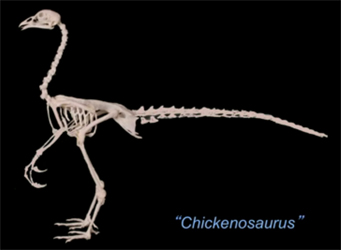 |
| The skeleton of the hypothetical 'Chickenosaurus', a chicken that has it's dinosaurian genes reactivated. Could become a 'true dinosaur' with some dinosaur genes extracted from fossils. |
There is another way of using this method to have more 'realistic' dinosaurs and be able to bring back most of our favorite dinosaurs, but that goes into another can of worms, another kind of debate, and will be discussed in a future post.
All the same, while they will not be pure dinosaurs, they are dinosaur enough to satisfy our need and desire to see them roam the earth again. But the next time you see a chicken or an emu, make sure you treat it right 'cause one of it's descendants might become the pseudo-dinosaurs and might have you for lunch.
=Conclusion=
Along with these and many other perspectives (which will be brought up in this blog in the future) that an Animal Scientist or an animal expert take out of the film or can reason about. I could imagine what you're thinking about as you read this:
"What's with the fuss about this science fiction movie?"
When it came to why I myself am having a fuss about this film is that it was thanks to the original Jurassic Park that has gotten me into where I am now.
I do not remember how old was I when I first saw it, but I could remember watching that movie over and over again for as long I could remember. While it did got it's science wrong here and there, it has sparked an interest in me; an interest in not just dinosaurs, but the science of animals in general. In order to truly understand dinosaurs and other extinct animals, you must understand the animals of today. So, this lead me to study animals more and (along with Steve Irwin and Temple Grandin) has helped lead me to study Animal Science.
When Jurassic World came up and I've learned about it in strides (leaks, featurettes, etc.), it was a grand deal to see my childhood franchise somewhat making the same kind of path that I have (using it as a way to talk about our relationship that we have with modern animals today). Along with that, seeing the film come up on the same year that I have graduated seems to be just perfect.
Whether you would feel the same way about this film or not, I would have to say that this film is not only a fresh new reboot for the franchise, but a clever tool to inspire and entertain the general public of today, jut as it's predecessor did before it.


Comments
Post a Comment