American Bison in the Great Karoo
Being an animal nut, I tend to wonder what would happen if one species established itself into another environment; like how it would compete with other species, deal with native predators, what kind of effects it would have on the local flora, etc.
Well, one thought popped up in my head and it was "What if American Bison were introduced to wilds of Sub-Saharan Africa?"
Loads of thoughts came into my head, to the point that I even googled "American Buffalo Africa" kinda just for the heck of it and I got myself a wee bit of a surprise.
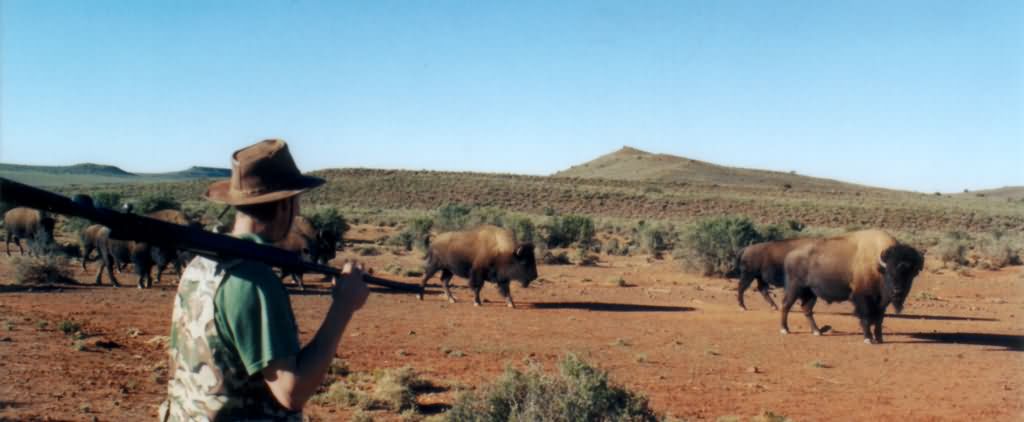
In the Great Karoo (a semi-desert region in South Africa, think of it as the African version of New Mexico), there is a private game reserve called Ratelfontein that actually seems to be one of the only 2 places (along with the Lion and Rhino Park in Kromdraai) in South Africa where American Bison could be seen in the wild. They have been there since the 1990's.
 |
| American Bison hunted.....in AFRICA!? |
Habitat?
With any species, the bison would no doubt have an affect on the habitat it inhabits. Knowing the bison itself, here's a short list of possible effects:
-With it being a grazing mammal, it would graze on grass and similar plants.
-Rubbing would tear down shrubs and trees, disturbing their growth and killing the trees and shrubs.
-Rolling around and manure would spread around seeds, especially of invasive plant species.
-Rolling around would also make a buffalo wallow, which would also could become waterholes after a good rain storm. While it could provide water for the native wildlife, it could become a possible breeding group for mosquitos.
-Speaking of watering holes, the buffalo might actually concentrate it's activities at riparian areas (areas close to water), due to lack of adequate predators patrolling watering holes. Staying at riparian areas for extended periods of time would disrupt riparian plants, which doing so would increase the instance of soil erosion and slit runoff.
With any species, the bison would no doubt have an affect on the habitat it inhabits. Knowing the bison itself, here's a short list of possible effects:
-With it being a grazing mammal, it would graze on grass and similar plants.
-Rubbing would tear down shrubs and trees, disturbing their growth and killing the trees and shrubs.
-Rolling around and manure would spread around seeds, especially of invasive plant species.
-Rolling around would also make a buffalo wallow, which would also could become waterholes after a good rain storm. While it could provide water for the native wildlife, it could become a possible breeding group for mosquitos.
-Speaking of watering holes, the buffalo might actually concentrate it's activities at riparian areas (areas close to water), due to lack of adequate predators patrolling watering holes. Staying at riparian areas for extended periods of time would disrupt riparian plants, which doing so would increase the instance of soil erosion and slit runoff.
Predators?
When being hunted, the bison that would be most at risk would be the bulls (due to their solitary lives outside of mating season) and young, other than the sick and the wounded.
There used to be lions, painted dogs, and hyenas in the area and they would definitely be a challenge for the buffalo. But, due to hunting, they've became locally extinct there (however, they are in the process of being reintroduced into the Great Karoo).
But, for the sake of the argument, what would the bison's chances with these three predators be like?
With African lions, it would be pretty interesting. The closest thing to knowing what the relationship would be like are fossil record from the ice age. According to studies done on ancient bison of Ice Age North America, it seems that the large and long horns of the said bison were an adaptation to the American lions that hunted them during that time. And in the absence of such predators, the surviving bison grew shorter horns and became the bison that we know today. With these much smaller horns, the modern bison would have some trouble in repelling lions. An individual lion would perhaps be not much of a challenge, but a pride of lions might be.
With African Painted, Wild, or Hunting dogs, they would probably be no different to the bison than grey wolves are in their native homeland. Perhaps the only difference is that since the hunting success of these dogs is significantly higher than that of wolves (Wolves are successful 3-14% of the time, whereas African Painted dogs are successful between 60-90%), they would be a tougher opponent to the bison.
-Hyenas
Now with the hyenas (spotted hyenas), they would most certainly present an immense challenge for the bison. The spotted hyenas are stronger and smarter than wolves, they would hunt them more often than wolves would. Spotted hyenas have one of the most powerful bite forces in the animal kingdom and their jaws can inflict serious damage on the bison.
Leopards and jackals are the only large predators that are currently present in the Great Karoo that could bother the bison, but not by much. Due to their similarities to cougars and coyotes of North America, so one can assume that the leopards' and jackals' interaction with the bison might be similar.
With the jackal, it could go after calves (if they could get pass the mothers). Although, due to the bison's anti-predator behavior, it would be most likely that the jackal would prefer to scavenge.
Out of the two predators, the leopard might be the more significant predator to the bison here. While the leopard would most likely prefer to go after lighter-built prey (e.g. antelope, warthogs, etc.), there are cases where the leopard has gone after prey that are within the weight range of bison. So while the leopard would perhaps be an occasional predator to the bison, it won't be a sufficient one (especially since they are more secretive).
When being hunted, the bison that would be most at risk would be the bulls (due to their solitary lives outside of mating season) and young, other than the sick and the wounded.
There used to be lions, painted dogs, and hyenas in the area and they would definitely be a challenge for the buffalo. But, due to hunting, they've became locally extinct there (however, they are in the process of being reintroduced into the Great Karoo).
But, for the sake of the argument, what would the bison's chances with these three predators be like?
With African lions, it would be pretty interesting. The closest thing to knowing what the relationship would be like are fossil record from the ice age. According to studies done on ancient bison of Ice Age North America, it seems that the large and long horns of the said bison were an adaptation to the American lions that hunted them during that time. And in the absence of such predators, the surviving bison grew shorter horns and became the bison that we know today. With these much smaller horns, the modern bison would have some trouble in repelling lions. An individual lion would perhaps be not much of a challenge, but a pride of lions might be.
With African Painted, Wild, or Hunting dogs, they would probably be no different to the bison than grey wolves are in their native homeland. Perhaps the only difference is that since the hunting success of these dogs is significantly higher than that of wolves (Wolves are successful 3-14% of the time, whereas African Painted dogs are successful between 60-90%), they would be a tougher opponent to the bison.
-Hyenas
Now with the hyenas (spotted hyenas), they would most certainly present an immense challenge for the bison. The spotted hyenas are stronger and smarter than wolves, they would hunt them more often than wolves would. Spotted hyenas have one of the most powerful bite forces in the animal kingdom and their jaws can inflict serious damage on the bison.
Leopards and jackals are the only large predators that are currently present in the Great Karoo that could bother the bison, but not by much. Due to their similarities to cougars and coyotes of North America, so one can assume that the leopards' and jackals' interaction with the bison might be similar.
With the jackal, it could go after calves (if they could get pass the mothers). Although, due to the bison's anti-predator behavior, it would be most likely that the jackal would prefer to scavenge.
Out of the two predators, the leopard might be the more significant predator to the bison here. While the leopard would most likely prefer to go after lighter-built prey (e.g. antelope, warthogs, etc.), there are cases where the leopard has gone after prey that are within the weight range of bison. So while the leopard would perhaps be an occasional predator to the bison, it won't be a sufficient one (especially since they are more secretive).
Other Herbivores?
In the past, the Great Karoo used to have large herds of hoof stock roaming the area. However, activities of the European colonists have decimated these herds drastically and while conservation efforts have helped the remaining herd, they are still no where near what they were prior to European colonization. With all this in mind and there still being a lot of land, competition against the bison would perhaps be at a bare minimum. That is not to say that there wouldn't be 'speed bumps'.
In the main grazing department, wildebeest and bison would be in direct competition with each other since that they both occupy the exact same niche. What the bison have going for them is that they are larger in size and much stronger, so they can be able to bully wildebeest away. But wildebeest have population size on their side (since their species maintain one of the last large scale land migrations in nature) and knowledge of their environment. Also, wildebeest can "fight back" with Malignant Catarrhal Fever (MCF). MCF is a devastating disease that infects ruminant mammals and is fatal. Wildebeest are carriers of the said disease and this disease is extremely fatal to cattle and American bison.
In the interactions between other antelope species (springbok, blesbok, gemsbok, eland, etc.) and the bison, I believe, will be the most interesting interaction. In comparing the ecology between the bison's and wildebeest's with their neighbors in their native homelands, I would have to say that the antelope species would benefit from the bison just like how they would benefit from the wildebeest. How they would do that is that both bison and wildebeest would graze on the taller and course grasses and by doing so, they will expose the smaller plants and herbs that are higher quality, yet are impalatable to both bison and wildebeest. However, these types of plants are perfect for the antelope species. We know that this is true to wildebeest with the other native antelopes, but why would this be true with bison? Well, both bison and cattle would do the exact same thing for the elk in North America and it stands to reason that it would still apply for African antelope.
In the interactions between other antelope species (springbok, blesbok, gemsbok, eland, etc.) and the bison, I believe, will be the most interesting interaction. In comparing the ecology between the bison's and wildebeest's with their neighbors in their native homelands, I would have to say that the antelope species would benefit from the bison just like how they would benefit from the wildebeest. How they would do that is that both bison and wildebeest would graze on the taller and course grasses and by doing so, they will expose the smaller plants and herbs that are higher quality, yet are impalatable to both bison and wildebeest. However, these types of plants are perfect for the antelope species. We know that this is true to wildebeest with the other native antelopes, but why would this be true with bison? Well, both bison and cattle would do the exact same thing for the elk in North America and it stands to reason that it would still apply for African antelope.
Anyone who has kept bison can tell you that it is best to not keep horses with them, since bison have been known to be pushy and would even gore them to death. With this in mind, it shouldn't be surprising that they might be pushy with Rau Quagga (plains zebra that are selectively bred to resemble the extinct Quagga). However, they would probably be surprised with the zebra's aggression, which is more so than that of horses.
Out of all the possible inter-specific interactions between the bison and native wildlife, two of them strikes me as the most interesting:
One of them I think might be destructive and that would be with the riverine rabbit.
The riverine rabbit is a critically-endangered species of rabbit (this and other species of endangered species of rabbits will be described in a future article) that is found only the Karoo. They are critically-endangered due to their specific habitat requirements (seasonal river areas, prone to erosion and destruction from over-grazing and crops) and their slow reproduction (one offspring per year). With the possible destructive capabilities that bison could have to the environment (mentioned earlier), the bison could push the rabbit further into extinction.
Another interaction that I would find to be the most interesting is interacting with the TRUE buffalo; the cape buffalo.
Out of all the possible inter-specific interactions between the bison and native wildlife, two of them strikes me as the most interesting:
One of them I think might be destructive and that would be with the riverine rabbit.
 |
| Riverine Rabbit (credit: Karoo Space) |
Another interaction that I would find to be the most interesting is interacting with the TRUE buffalo; the cape buffalo.
_male_with_cattle_egret.jpg) |
| The Cape Buffalo (photo from Wikipedia) |
While the American bison is a pretty tough bovine itself, it would be considered a 'pansy' compared to the Cape Buffalo. While bison do have thick skull themselves, the 'boss' (set of horns) of the water buffalo is thicker than the bison's skull. And speaking of those horn; while the bison's horns are sharp, they are immensely short in comparison to those the cape buffalo. They horns can deliver deeper gore marks than the bison can and these horns are so effective that they can keep lions at bay.
There perhaps more things about the cape buffalo that would make them tough customers for the bison and this species might perhaps humble the american bison up front.
Conclusion?
From all this, I could most definitely conclude that these would the most possible affects that the American Bison could have the Great Karoo in South Africa.
References
Hamilton, P.H. (1976). The movements of leopards in Tsavo National Park, Kenya, as determined by radio-tracking (M.Sc. thesis). Nairobi: University of Nairobi.
Heuschele, W. P., Oosterhuis, J., Anderson, M. P., Swansen, M., & Fletcher, H. R. (1984). Malignant catarrhal fever in wild ruminants. In One Medicine (pp. 296-308). Springer, Berlin, Heidelberg.
http://ace.mandela.ac.za/ace/media/Store/documents/Technical%20reports/ACE-Report-62-Kerley-Boshoff-Mammal-introductions-WN-Cape.pdf
http://factsanddetails.com/asian/Northern_Asian_and_European_Animals/sub2_8a/entry-4905.html
https://krugersdorpnews.co.za/235846/america-no-kromdraai/
http://www.iws.org/CISProceedings/6th_CIS_Proceedings/Sweitzer_et_al.pdf
Schaller, George B. (1973). Golden Shadows, Flying Hooves. New York: Alfred A. Knopf. p. 277.
Heuschele, W. P., Oosterhuis, J., Anderson, M. P., Swansen, M., & Fletcher, H. R. (1984). Malignant catarrhal fever in wild ruminants. In One Medicine (pp. 296-308). Springer, Berlin, Heidelberg.
http://ace.mandela.ac.za/ace/media/Store/documents/Technical%20reports/ACE-Report-62-Kerley-Boshoff-Mammal-introductions-WN-Cape.pdf
http://factsanddetails.com/asian/Northern_Asian_and_European_Animals/sub2_8a/entry-4905.html
https://krugersdorpnews.co.za/235846/america-no-kromdraai/
http://www.iws.org/CISProceedings/6th_CIS_Proceedings/Sweitzer_et_al.pdf
Schaller, George B. (1973). Golden Shadows, Flying Hooves. New York: Alfred A. Knopf. p. 277.
Sunquist, M.E.; Sunquist, F. (2002). "Leopard". Wild Cats of the World. Chicago: University of Chicago Press. pp. 325–342.


Comments
Post a Comment